
- 1800 6129


Source: SIAM Brothers Vietnam
Southeast Asia has extensive coastlines, numerous rivers and lakes, and a well-developed aquaculture sector. These conditions generate significant demand for floats, fish cages, floating docks and other infrastructure used on or near the water.
According to the Southeast Asian Fisheries Development Center, aquaculture production in the region exceeded 26.4 million tonnes in 2023, accounting for approximately 55% of total fisheries production by volume. Mariculture contributed around 40% of regional aquaculture output. These figures illustrate the scale of marine and coastal farming activities and the resulting need for suitable floating infrastructure (SEAFDEC, 2025).
Beyond aquaculture, HDPE floats are used in floating walkways, small-vessel docks, work platforms, waterfront tourism facilities and certain floating solar systems. However, the term “HDPE floating buoy” is often used for several different product categories.
Common product categories include:
Cylindrical floats for oyster, shellfish or seaweed farming.
Buoyancy components for floating fish cages.
Modular pontoon cubes for docks, walkways and platforms.
Mooring, marker and navigational support buoys.
Pipe floats and technical support floats.
Custom-designed floating structures for individual projects.
Although these products may all use polyethylene materials, they differ in shape, construction, accessories and intended operation. A modular pontoon designed for a floating walkway is not automatically suitable for oyster farming. Similarly, a marker buoy is not intended to support people or heavy equipment.
Selecting a manufacturer should therefore begin with the intended application rather than the material name or the visual appearance of a product.
High-density polyethylene is a thermoplastic used in many outdoor and water-based products. Depending on material formulation, product design and manufacturing process, HDPE can offer several characteristics suitable for floating structures:
It does not rust like metal.
It does not decay in the same way as wood.
It can be formed into different shapes using several manufacturing processes.
Its relatively low weight can facilitate transport and assembly.
It can be designed as a modular system for replacement or expansion.
It can be used in different aquatic environments when selected for the correct application.
However, not every product labelled “HDPE” has the same quality or expected service life. Performance also depends on material formulation, wall thickness, additives, production technology, connection design and operating conditions.

Source: SIAM Brothers Vietnam
There is currently no independent regional ranking that evaluates every HDPE buoy manufacturer under one common standard. In this article, the term “top manufacturers” refers to notable companies with verifiable manufacturing information, product ranges or completed projects.
The following list is not a ranking from best to worst. Each manufacturer has different product strengths and market focuses.
Customers should distinguish a manufacturer from a business that only imports or distributes products. A manufacturer should be able to provide information about:
Production location or facilities.
Manufacturing technology.
Material quality control.
Available sizes and configurations.
Custom manufacturing capability.
Inspection procedures before delivery.
Having a manufacturing plant does not automatically guarantee that every product is suitable for a particular project. However, it provides a basis for assessing quality control and long-term supply capability.
A product page that only describes a float as “durable”, “wave-resistant” or “long-lasting” does not provide enough information for selection. Buyers should request data that can be compared, including:
Material type.
Dimensions and product weight.
Buoyancy or designed load capacity.
Connection-point construction.
Compatible accessories.
Intended applications.
Operating and warranty conditions.
The specification of an individual float does not replace a calculation for the entire system. Total load, float spacing, anchoring method and water conditions can all affect performance.
A manufacturer specialising in modular pontoons may not be suitable for an oyster-farming project. Likewise, an aquaculture-float producer may not manufacture navigational buoys or industrial floating structures.
Before contacting a supplier, customers should determine whether they need:
Oyster or shellfish floats.
Floating fish cages.
Floating walkways or docks.
Marker buoys.
Pipe-support floats.
A custom-designed floating system.
Correctly defining the requirement shortens the consultation process and prevents comparisons between products intended for different functions.
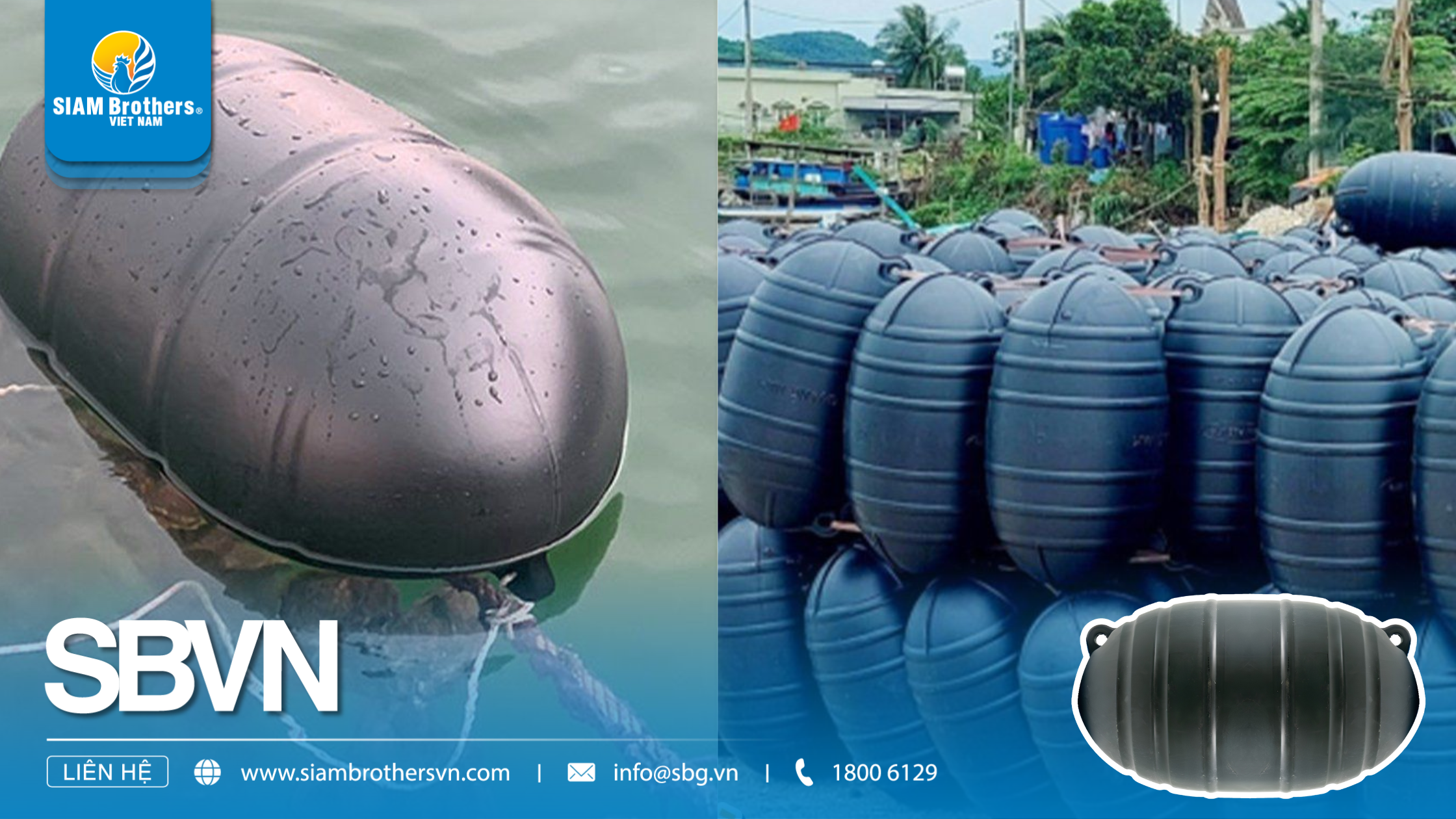
Oyster-farming Floating - Source: SIAM Brothers Vietnam
A float is only one component of a complete system. Depending on the project, additional components may include frames, ropes, nets, cables, connecting pins, decking, handrails and anchors.
For projects involving high loads or complex water conditions, the supplier should consider:
Waves, wind and currents.
Water depth and water-level variation.
Seabed conditions.
Static and operational loads.
Access routes for people and vessels.
Inspection, maintenance and replacement procedures.
Customers should confirm the warranty scope, availability of replacement components and technical-support arrangements. When products are imported from another country, transport costs and lead times for spare parts should also be included in the total investment assessment.
SIAM Brothers Vietnam manufactures and supplies ropes, nets, floats and integrated solutions for aquaculture and water-based infrastructure. We provide several types of HDPE floating products for applications ranging from oyster cultivation and floating fish cages to modular docks and platforms.
For shellfish farming, SIAM’s HDPE oyster float has the following published specifications:
Material: HDPE.
Colour: black.
Dimensions: 300 × 600 mm.
Product weight: 2.3–2.5 kg.
Published buoyancy: 80 kg.
The published buoyancy figure does not mean that every float should be loaded independently to that level. When planning a farming line, the total weight of ropes, seed stock, growing biomass, accessories and environmental loads must be considered.
For walkways, docks and floating platforms, SIAM also provides modular HDPE pontoon units measuring 500 × 500 × 400 mm. These units can be connected according to the project design to create a floating surface of the required size and configuration.
SIAM’s role is not limited to supplying individual floats. We can combine floats with ropes, nets, accessories and site-specific implementation plans. Published projects include HDPE fish cages in Quang Ninh, floating cage systems in Cambodia and tourism-related floating structures in Phu Quoc and other locations.
Project: Four double-unit HDPE fish cages in Quang Ninh
Project: Floating Stage at Kiss Bridge, Phu Quoc | SIAM Brothers Vietnam
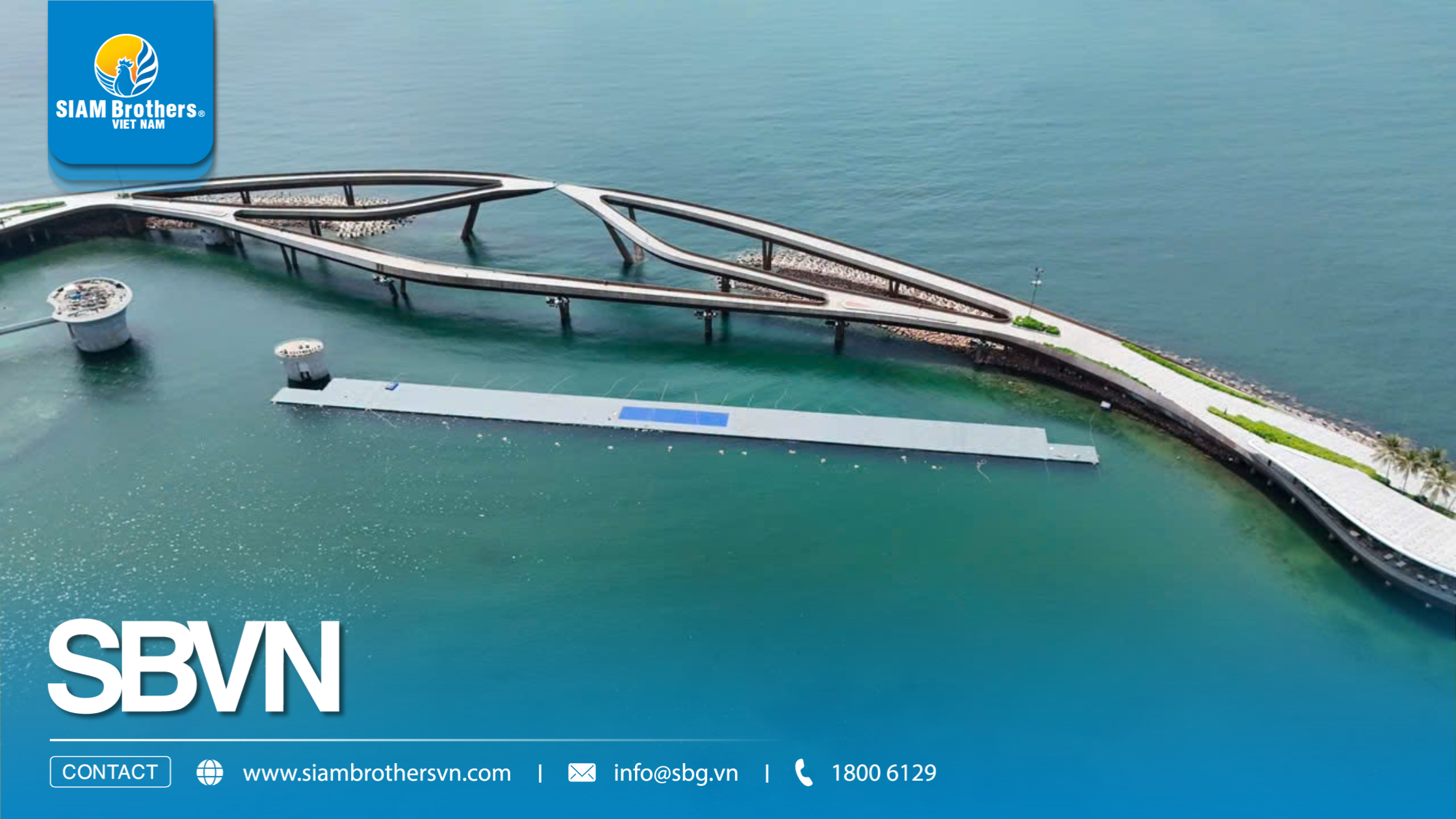
Floating Stage at Kiss Bridge, Phu Quoc - Source: SIAM Brothers Vietnam
Every project requires an individual assessment. A configuration used successfully at one location should not be copied directly to a new site without evaluating local conditions.
FLOT Indonesia is a floating-system brand manufactured by PT Catur Manunggal Elektromekanik in Indonesia. The company states that it has manufactured modular floating products since 1989 and uses HMHDPE with UV stabilisers for outdoor applications.
FLOT products can be assembled into:
Floating walkways.
Floating docks.
Work platforms.
Floating surfaces for leisure and commercial activities.
This product range belongs to the modular pontoon category. It should not be described as a range of oyster floats or marine navigational buoys. FLOT presents projects in Jakarta, Bali and the Kapuas River area as examples of its floating-system applications.
When considering FLOT products, buyers should request technical documents for the specific model, connection system and operating limits intended for the proposed site.
Aquatec is a brand of PT Gani Arta Dwitunggal, an Indonesian company established in 1993. It manufactures HDPE marine and fisheries infrastructure, including:
Floating fish cages.
Floating docks.
HDPE boats.
Seaweed floats.
Marker buoys.
Other floating products for marine applications.
Aquatec describes a manufacturing facility in West Java equipped with pipe-extrusion, injection-moulding, rotational-moulding and blow-moulding machinery. According to the company profile, more than 22,000 Aquatec floating-cage units had been installed in Indonesia and several international markets by 2025.
Aquatec’s broad product portfolio is noteworthy. However, customers should distinguish between individual floats, complete cage systems, boats and other floating structures because these product groups involve different production methods and technical criteria.
HUKSIN Thailand focuses on HDPE floating offshore structures. The company presents itself as a direct manufacturer and supplier of floating structures for marine applications in Thailand.
Customers evaluating HUKSIN should review the relevant product range, project records, material specifications and service coverage available for the intended location. Statements regarding exclusivity or market leadership on a company website should be treated as company-provided information unless independently verified.
HUKSIN may be considered for projects involving offshore floating structures. Its suitability still depends on the specific application and the technical documentation available for each proposed product.
Premierfloat manufactures modular HDPE pontoon systems in Malaysia. Its product range focuses on floating blocks that can be assembled into:
Boat docks and jetties.
Service platforms.
Equipment-support platforms.
Floating stages.
Floating solar support systems.
Leisure and commercial floating structures.
Premierfloat states that its products are manufactured under a quality management system certified by Bureau Veritas Certification as conforming to ISO 9001:2015. However, certification of a quality management system does not mean that every project configuration is automatically certified for load capacity or suitability in all environmental conditions.
Premierfloat belongs primarily to the modular pontoon category. It is therefore more relevant to floating walkways, docks and platforms than to oyster-farming floats or specialised marker buoys.
The regional manufacturer list illustrates the diversity of the Southeast Asian market. For projects in Vietnam, local site assessment, transport, installation and after-sales support should also be considered.
SIAM supplies HDPE oyster floats and components for floating fish-cage systems. Depending on the farming model, the floats can be combined with ropes, nets, frames and anchoring components.
Before selecting a configuration, farmers should determine:
The cultivated species and farming method.
Number of ropes or cages.
Expected biomass.
Wave and current conditions.
Water depth.
Spacing between floats.
Inspection and harvesting methods.
We do not recommend determining the number of floats simply by dividing the total estimated weight by the published buoyancy of one unit. Safety allowance, dynamic loads and load distribution should also be considered.
Modular HDPE pontoon units can be assembled into different surface dimensions and shapes. They are suitable for projects that require expansion, reconfiguration or replacement of individual components.
Depending on the application, a floating system may also require:
Handrails.
Slip-resistant surfaces.
Shore-access gangways.
Anchoring systems.
Protective fenders.
Signs and operational safety equipment.
The layout should not be based solely on the required surface area. The number of users, equipment loads, access direction and water-level variation can all affect the final configuration.
To support an initial assessment, customers should provide SIAM with:
Proposed installation location.
Site photographs or videos.
Required dimensions.
Intended use.
Estimated loads.
Number of people or equipment operating simultaneously.
Water depth, currents and water-level variation.
Transport and installation requirements.
Expected implementation schedule.
More complete information allows the proposed configuration and quotation to reflect the actual project scope. The price of an individual pontoon unit does not represent the total cost of a complete floating system.
“Top HDPE floating buoy manufacturers in Southeast Asia” is a useful search term for exploring the market, but company recognition should not be the only selection factor.
First, determine whether the float will provide buoyancy, mark a location, support aquaculture or create a floating surface. If a project includes several functions, separate the technical requirements for each component.
An oyster float should not be compared directly with a modular pontoon based only on the price per unit. The two products have different functions, dimensions and installation methods.
Comparable information should include:
Material.
Dimensions.
Product weight.
Buoyancy or designed load capacity.
Accessories.
Operating conditions.
Warranty coverage.
Transport and installation costs.
For floating cages, docks or work platforms, customers should request a description of the complete system rather than only a quotation for individual floats. A clear proposal should identify:
Number and type of floats.
Connection accessories.
Frame or decking structure.
Anchoring system.
Transport costs.
Installation scope.
Operating and maintenance guidance.
Reference projects should be reasonably similar to the proposed application and water conditions. A configuration used for a floating walkway on a sheltered lake should not automatically be applied to an exposed marine site with waves and tidal variation.
Project photographs can indicate implementation experience, but they do not replace drawings, technical specifications or site assessments.
The option with the lowest initial unit price is not necessarily the most economical over time. Customers should also consider:
Installation costs.
Anchoring costs.
Replacement accessories.
Periodic inspection requirements.
Expansion capability.
Spare-part lead times.
Repair costs if one component is damaged.
A suitable system should meet the operational requirement and remain practical to inspect, maintain and repair throughout its service life.

Source: SIAM Brothers Vietnam
Southeast Asia has several manufacturers of HDPE floats and floating structures, but their specialisations differ. SIAM Brothers Vietnam provides aquaculture floats and floating solutions for various projects; FLOT Indonesia and Premierfloat focus on modular pontoons; Aquatec offers a broad range of fisheries and marine infrastructure; and HUKSIN Thailand focuses on offshore floating structures.
Because no independent ranking covers the entire regional industry, the phrase “top HDPE floating buoy manufacturers in Southeast Asia” should not be interpreted as an absolute ranking. The most suitable manufacturer should be selected according to product category, technical specifications, project experience and local support capability.
Customers seeking HDPE floats for aquaculture, floating walkways, docks or work platforms can provide SIAM Brothers Vietnam with site and project information. We can then discuss the intended use, recommend an appropriate configuration and prepare a quotation based on the actual scope.
Further reading: Reliable HDPE Oyster Float Manufacturer in Vietnam 2026
Source: SIAM Brothers Vietnam
Southeast Asian Fisheries Development Center. (2025). Fisheries statistics summary 2023. https://www.seafdec.org/stat2023/
Q: Which company is the best HDPE floating buoy manufacturer in Southeast Asia?
A: There is no independent ranking that applies to every buoy category. The most suitable manufacturer depends on the project type, required technical specifications, installation location and support services.
Q: Are HDPE floating buoys and modular pontoons the same product?
A: Not exactly. “HDPE floating buoy” is a broad term. A modular pontoon is a specific product category commonly used to create floating walkways, docks and platforms. Aquaculture floats and marker buoys have different designs, accessories and functions.
Q: Can a float be selected based only on its published buoyancy?
A: No. Buoyancy is important, but it must be considered together with total load, dynamic forces, float spacing, connection design, anchoring and water conditions.
Q: Does SIAM Brothers Vietnam supply HDPE oyster floats?
A: Yes. SIAM publishes an HDPE oyster float measuring 300 × 600 mm, weighing 2.3–2.5 kg and providing a published buoyancy of 80 kg. The final system configuration should be determined according to the farming model.
Q: Why is a site assessment necessary before installing an HDPE floating walkway?
A: A site assessment helps identify available space, water depth, water-level variation, currents, expected loads, access direction and anchoring locations. These factors are needed to develop a suitable system configuration.
Q: How is the price of an HDPE floating system calculated?
A: The total price depends on the type and quantity of floats, accessories, frames or decking, anchoring, transportation and installation scope. Customers should request a quotation for the complete configuration rather than compare only the price of individual float units.
Contact us:
Address: 5th floor, VRG Building, 177 Hai Ba Trung Street, Vo Thi Sau Ward, Ho Chi Minh City, Vietnam
Tel: (+84) 28 38 912 889
Hotline: 1800 6129
Facebook: www.facebook.com/siambrothersvn
Email: info@sbg.vn
YouTube: youtube.com/@siambrothersvietnam1728
OA Zalo: zalo.me/1402339229697925373
App SBVN ID:
CHPlay: https://bit.ly/SBVNID-Android
Appstore: https://bit.ly/SBVNID-iOS






Specializing in Agricultural and Fisheries Products & Multipurpose Wire