
- 1800 6129

Rope can be used to support plants, secure tarpaulins, organise equipment and assist with certain activities on boats. However, decorative rope should never be assumed to replace load-bearing rope or specialised equipment intended to protect people. To understand common applications and choose the right outdoor rope for each task, let’s explore the subject with SIAM Brothers Vietnam...
When used outdoors, rope may be exposed to sunlight, rain, moisture, dirt and abrasive surfaces. In coastal areas, salt, seawater and frequent wetting can also affect how rope should be used and maintained.
No single type of rope is suitable for every task. A rope used to organise lightweight tools has different requirements from a mooring rope, a towing line or a component in a personal protection system.
Important environmental factors include:
UV exposure: Prolonged sunlight can contribute to material ageing and changes in performance.
Water and moisture: Wet rope may retain dirt, organic matter or salt.
Abrasion: Rough surfaces, sharp edges and repeated movement can fray or cut rope fibres.
Heat: Heat sources, sparks and intense friction can deform synthetic rope.
Chemicals: Oil, solvents and unidentified chemicals may affect the rope material.
Resistance to these conditions depends on the material, construction and design of each product. Rope should not be selected based only on its colour or diameter.
Outdoor rope applications can be divided into three broad groups:
Decoration and organisation: Wrapping plant pots, making crafts or organising lightweight items.
General securing: Fastening tarpaulins, supporting plants or marking an area.
Specialised work: Mooring vessels, towing loads, lifting equipment, rescue or protecting people.
The third group requires specialised rope with appropriate technical specifications, compatible hardware and clear operating instructions. General-purpose rope should not automatically be used for these applications.
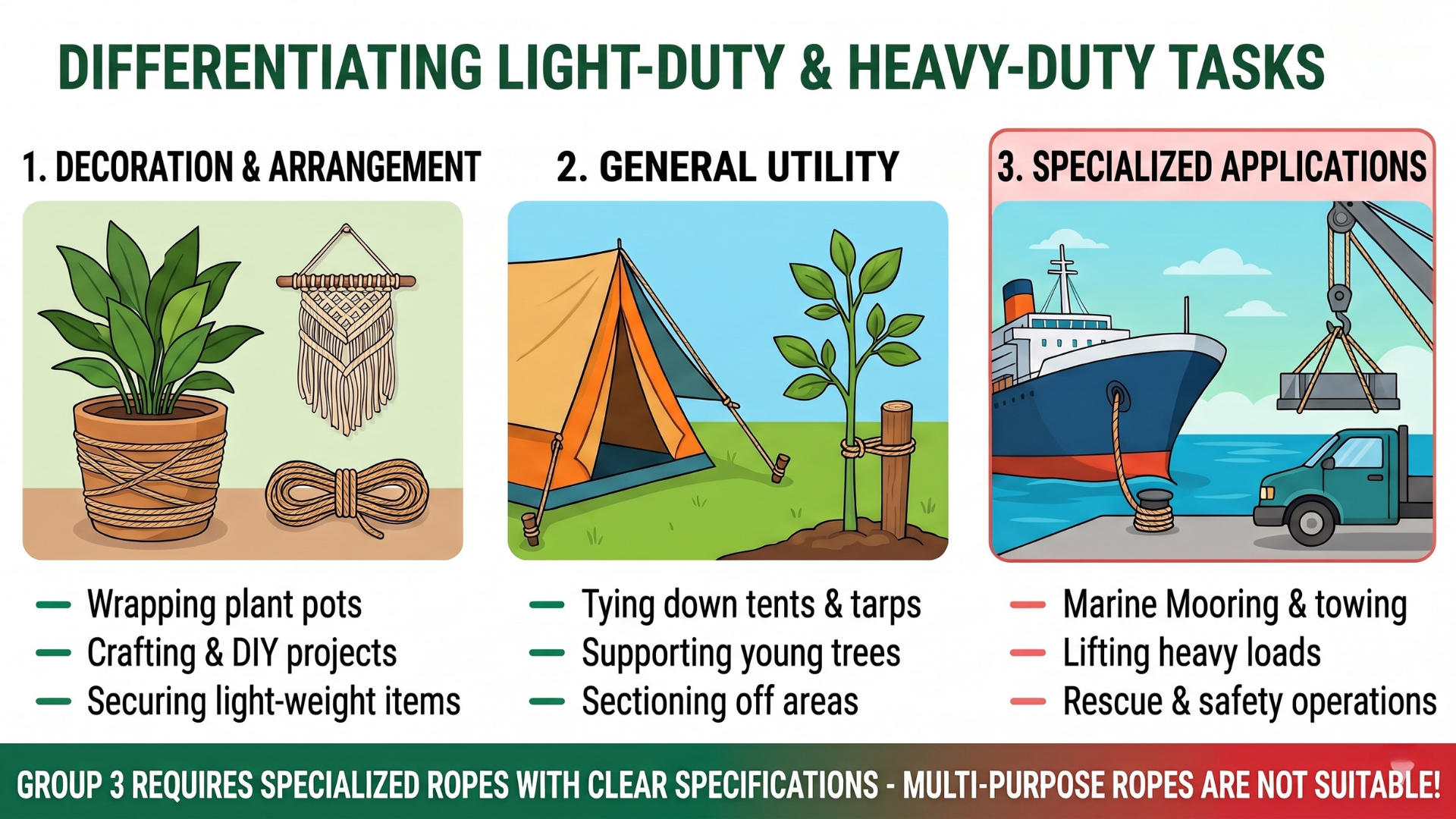
Distinguishing Light-Duty Tasks from Load-Bearing Work
Rope can support many activities in gardens, campsites and marine environments when it is selected and used for the correct purpose.
Rope can be used to:
Guide climbing plants.
Secure young plants to supporting stakes.
Support leaning stems or branches.
Mark planting beds and working areas.
Bundle bamboo poles, stakes and lightweight materials.
When tying a plant, leave enough space for the stem to continue growing. The rope should not be tightened directly against the plant because movement and growth may cause it to damage the surface of the stem.
Rope that has become stiff, heavily frayed or sharp should not be placed in direct contact with plants.
During an outdoor trip, rope may be used to:
Secure a tarpaulin.
Organise luggage.
Hang lightweight equipment.
Mark the boundaries of a campsite.
Fasten bags or tools in an appropriate location.
Before using the rope, consider the weight of the item, whether wind may change the applied force and whether the attachment point has sharp edges.
Rope with unknown specifications should not be used to make a load-bearing hammock, climbing line, fall-protection system or rescue device. Applications involving body weight require equipment designed and inspected for that purpose.
Rope is widely used in marine and fishing activities. Depending on the product, it may be used to:
Organise fishing gear.
Secure equipment on a boat.
Form headline or footrope components in suitable net configurations.
Connect parts of an aquaculture system.
Moor a vessel when the correct specialised rope is used.
A marine environment requires more than moisture resistance. Users must also consider buoyancy, elongation, abrasion resistance, load requirements and connection methods.
A rope that floats does not automatically qualify as a lifeline, mooring rope or device for towing people.
Clean and undamaged rope that does not need to carry a significant load may be used to:
Wrap plant pots or containers.
Add decorative details to a fence.
Create decorative netting.
Make hangers for lightweight items.
Produce knot boards and craft projects.
Natural-fibre rope often creates a rustic appearance, while synthetic rope is available in a wider range of colours and constructions. However, users should consider moisture absorption, outdoor ageing and fibre shedding.
Rope that is heavily soiled, contaminated with oil, decaying or shedding large quantities of fibres should not be brought into living areas.
Rope may also help organise a warehouse, yard or outdoor workspace:
Bundle hoses and tools.
Secure covers over stored items.
Mark storage areas.
Bundle bamboo, stakes and lightweight materials.
Hang suitable lightweight equipment.
Before hanging an item, inspect the rope, knot, hook and attachment point. The capacity of the system depends on its weakest component, not only on the rope.
Ordinary rope should not be treated as a replacement for a rated cargo tie-down system when the load and transportation conditions have not been determined.
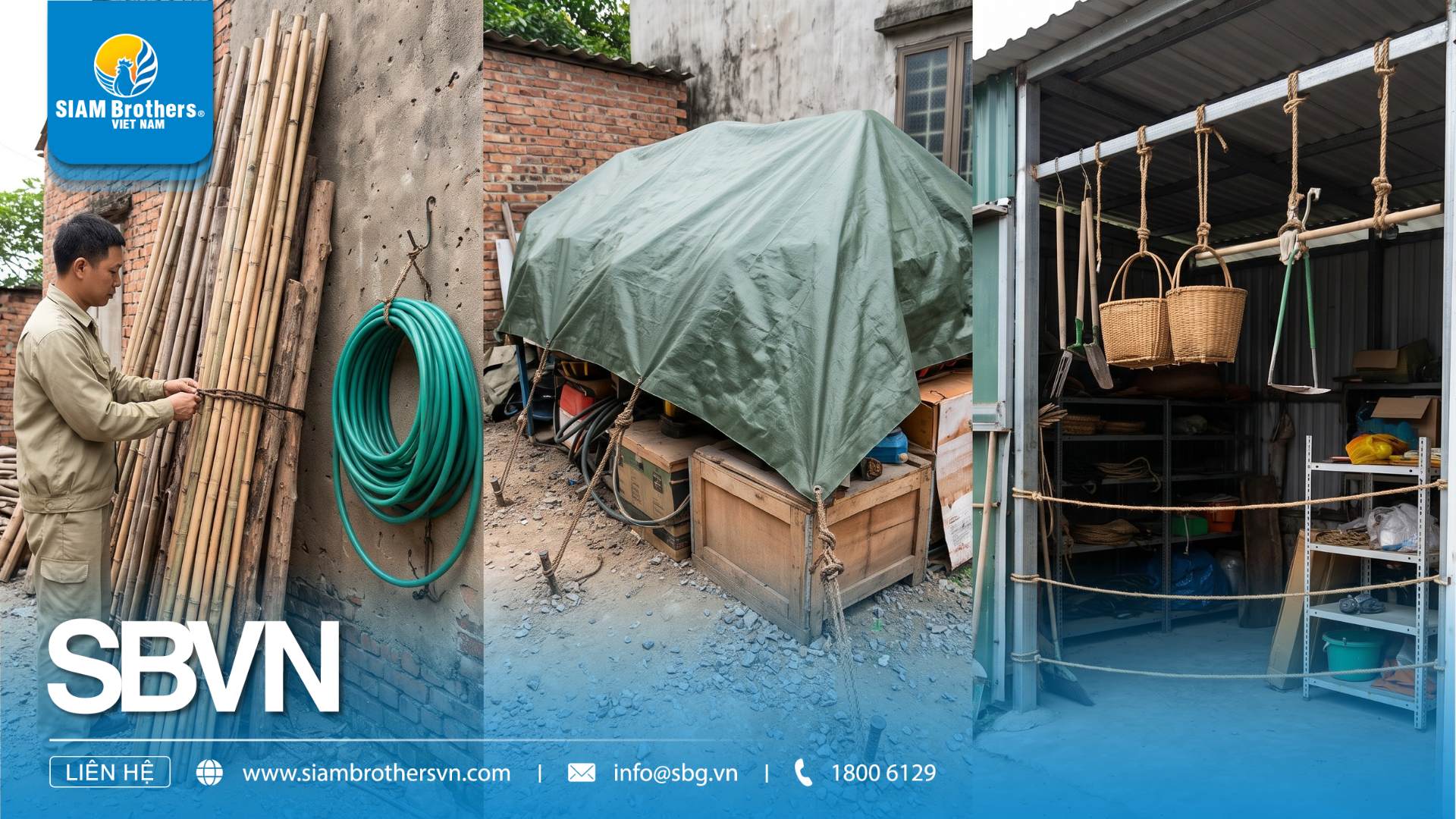
Organising and Securing Equipment
Each rope material has different characteristics. The following table provides general guidance; the technical specifications of the actual product should remain the main basis for selection.
|
Material |
General characteristics |
Applications to consider |
|
Polypropylene |
Lightweight, absorbs little water; some constructions can float |
Moist environments, fishing and securing suitable items |
|
Polyester |
Relatively low elongation and commonly considered for outdoor applications |
Tasks that require stable tension and dimensional stability |
|
Nylon |
Provides elongation and can absorb part of an applied force |
Specialised applications with defined specifications and instructions |
|
Natural fibre |
Rustic appearance but generally absorbs more moisture |
Decoration and light-duty work under suitable conditions |
In addition to the material, buyers should check:
Twisted or braided construction.
Rope diameter.
Stated load or intended application.
Exposure to sunlight and water.
Required elongation.
Knots and compatible hardware.
Inspection, cleaning and storage requirements.
Ropes made from the same material can still have different applications because of differences in construction, diameter and manufacturing. The fibre name alone is not sufficient for product selection.
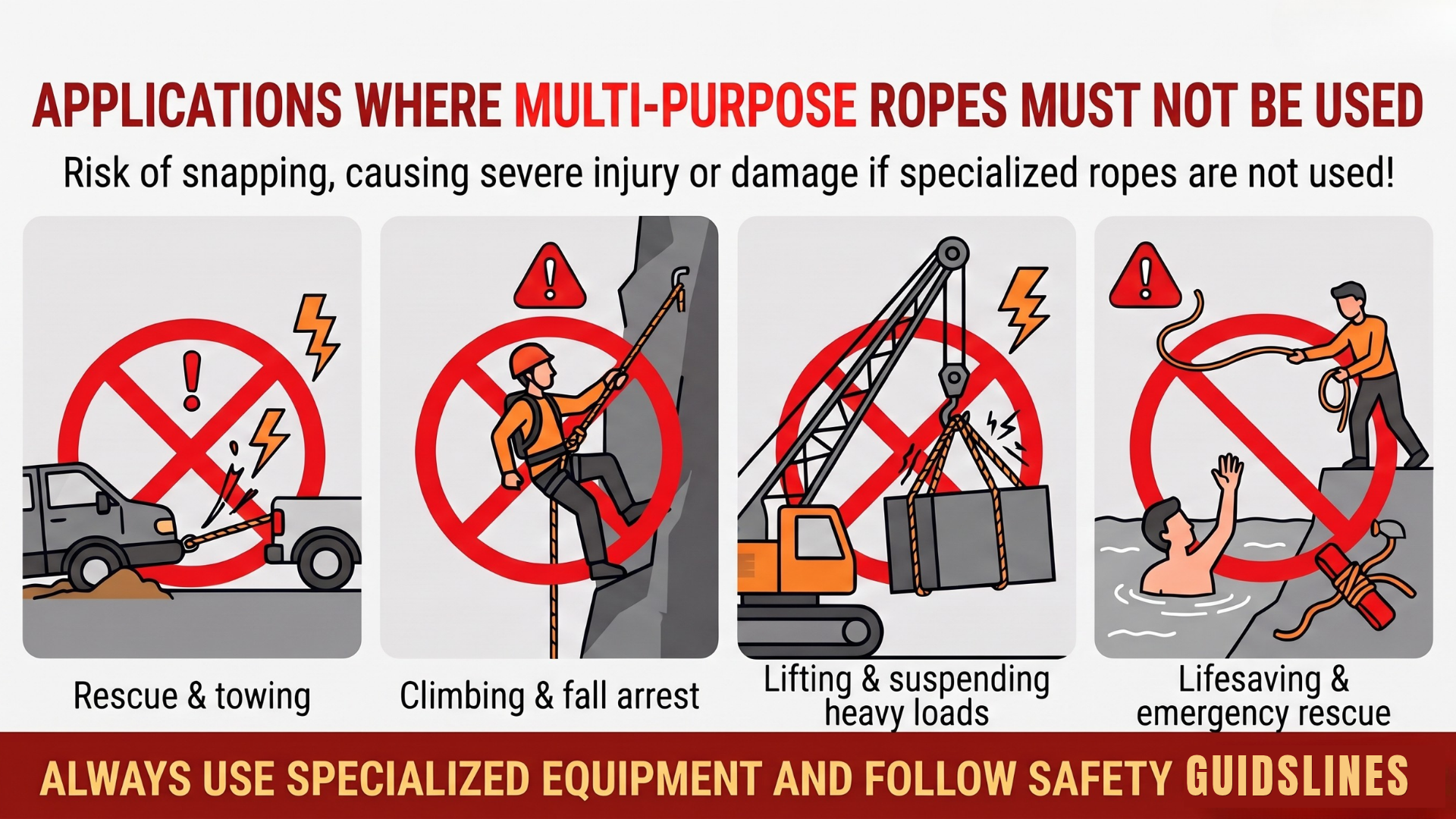
Applications That Should Not Use General-Purpose Rope
General-purpose rope should not be used casually for tasks that could cause serious injury or major property damage.
Applications that require specialised equipment include:
Towing or recovering vehicles.
Climbing and fall protection.
Lifting or suspending heavy objects overhead.
Making a lifeline.
Making a tourniquet or medical device.
Building a raft or flotation device for a person.
Mooring a vessel without knowing the rope’s characteristics and load capacity.
An unsuitable rope or connector may break and create dangerous recoil during vehicle recovery. Similarly, rope used in a fall-protection system must meet specific requirements for load capacity, connector compatibility and inspection.
In a medical emergency, appropriate first-aid equipment and proper training should be used instead of assuming that an ordinary rope can serve as a substitute.
Whenever a task directly affects personal safety, use specialised equipment and follow the instructions provided by its manufacturer or a qualified professional.
Rope should be inspected before it is coiled and stored, particularly after use in wet or coastal environments.
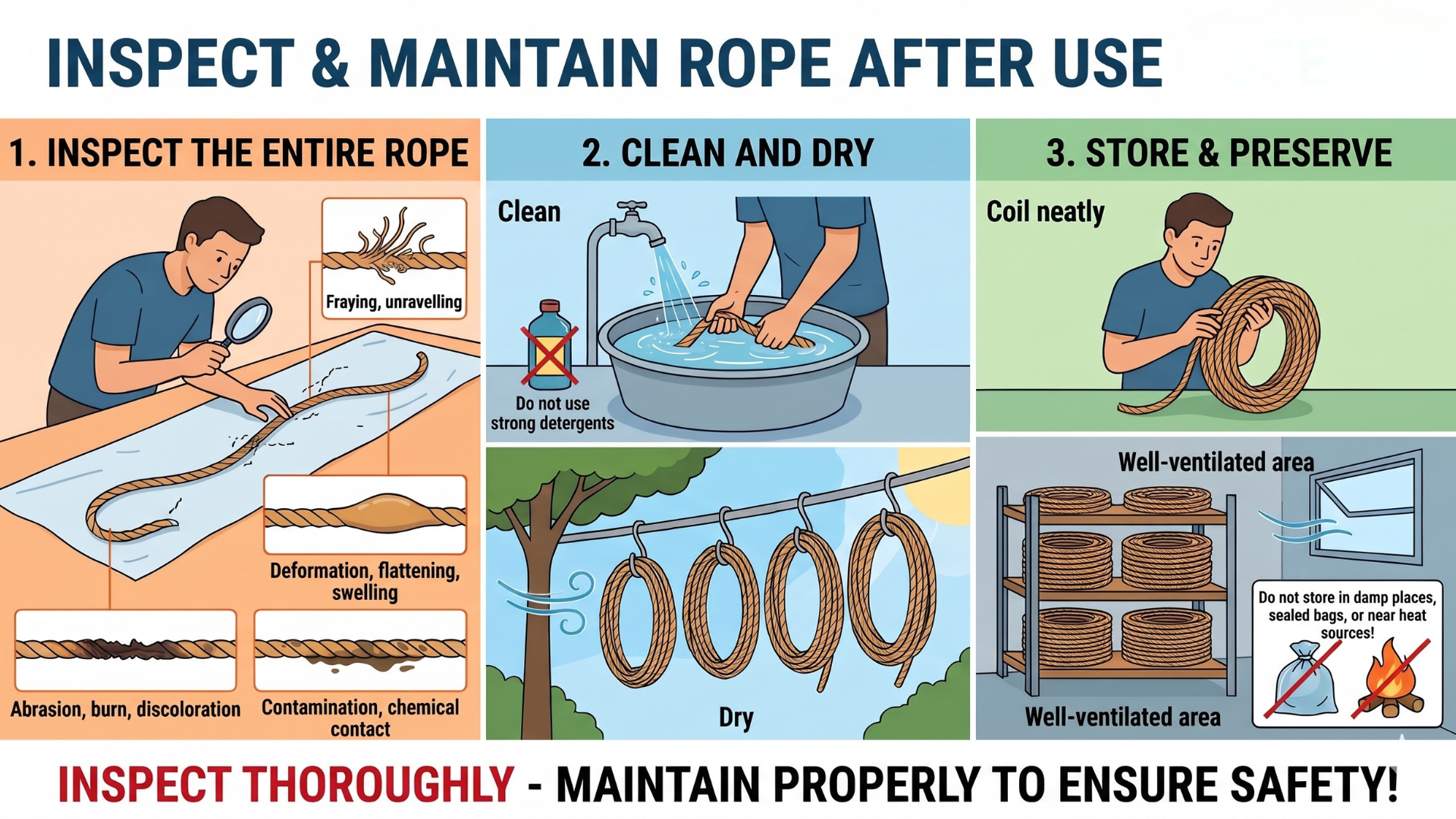
Inspect, dry and store rope in a well-ventilated area after outdoor use.
Lay the rope out in a clean area and inspect its full length. Look for sections that are:
Frayed or opening between strands.
Flattened, swollen or deformed.
Unusually stiff or soft.
Burnt, melted or discoloured.
Contaminated by oil or unidentified chemicals.
Heavily worn where the rope passed over an edge or through hardware.
If the rope is covered with mud, dirt or salt, clean it according to the manufacturer’s instructions. Do not use aggressive cleaning agents or solvents unless their compatibility with the rope material has been confirmed.
Allow the rope to dry in a well-ventilated area before coiling and storing it. Do not place wet rope in a sealed bag, directly on a damp floor or near a heat source.
When the extent of damage cannot be determined, separate the rope from equipment that remains in service. Do not return questionable rope to load-bearing work or tasks involving personal safety.
Outdoor rope can assist with many activities, from gardening and camping to equipment organisation and marine work. However, each application creates different requirements for the rope material, construction, diameter, elongation and load capacity.
The greater the load or personal safety risk, the more important it becomes to use suitable rope, compatible hardware and trained operators. Correct product selection, inspection before use and appropriate storage help reduce unnecessary risks.
Read more: SIAM Brothers Vietnam’s Used Rope Collection Programme
Source: SIAM Brothers Vietnam
Q: What type of rope is suitable for outdoor use?
A: Selection should be based on moisture, UV exposure, load, abrasion and the intended application. No single rope type is suitable for every outdoor task.
Q: Can polypropylene rope be used outdoors?
A: Yes, but its construction, additives, stated load and product-specific instructions should be checked before use.
Q: Can general-purpose rope be used to tow a vehicle?
A: It should not be used for this purpose. Vehicle towing and recovery require specialised equipment with a defined load capacity, suitable attachment points and clear operating instructions.
Q: Can old rope still be used outdoors?
A: Old rope may be used for light-duty work when it remains clean and undamaged and its history is known. It should not be used for load-bearing work or tasks involving personal safety.
Contact us:
Address: 5th floor, VRG Building, 177 Hai Ba Trung Street, Vo Thi Sau Ward, Ho Chi Minh City, Vietnam
Tel: (+84) 28 38 912 889
Hotline: 1800 6129
Facebook: www.facebook.com/siambrothersvn
Email: info@sbg.vn
YouTube: youtube.com/@siambrothersvietnam1728
OA Zalo: zalo.me/1402339229697925373
App SBVN ID:
CHPlay: https://bit.ly/SBVNID-Android
Appstore: https://bit.ly/SBVNID-iOS






Specializing in Agricultural and Fisheries Products & Multipurpose Wire