
- 1800 6129

Knowing how to prevent durian branches from breaking is particularly important when trees begin bearing fruit, especially before periods of heavy rain and strong winds or when fruit loads are unevenly distributed across the canopy. Unlike banana plants, which often require support for the entire pseudostem, mature durian trees mainly need reinforcement around fruit-bearing branches, branch unions and other load-bearing areas. An effective system should combine suitable ropes, secure anchor points or support poles and moderate tension. Let SIAM Brothers Vietnam explain how to arrange these components properly.
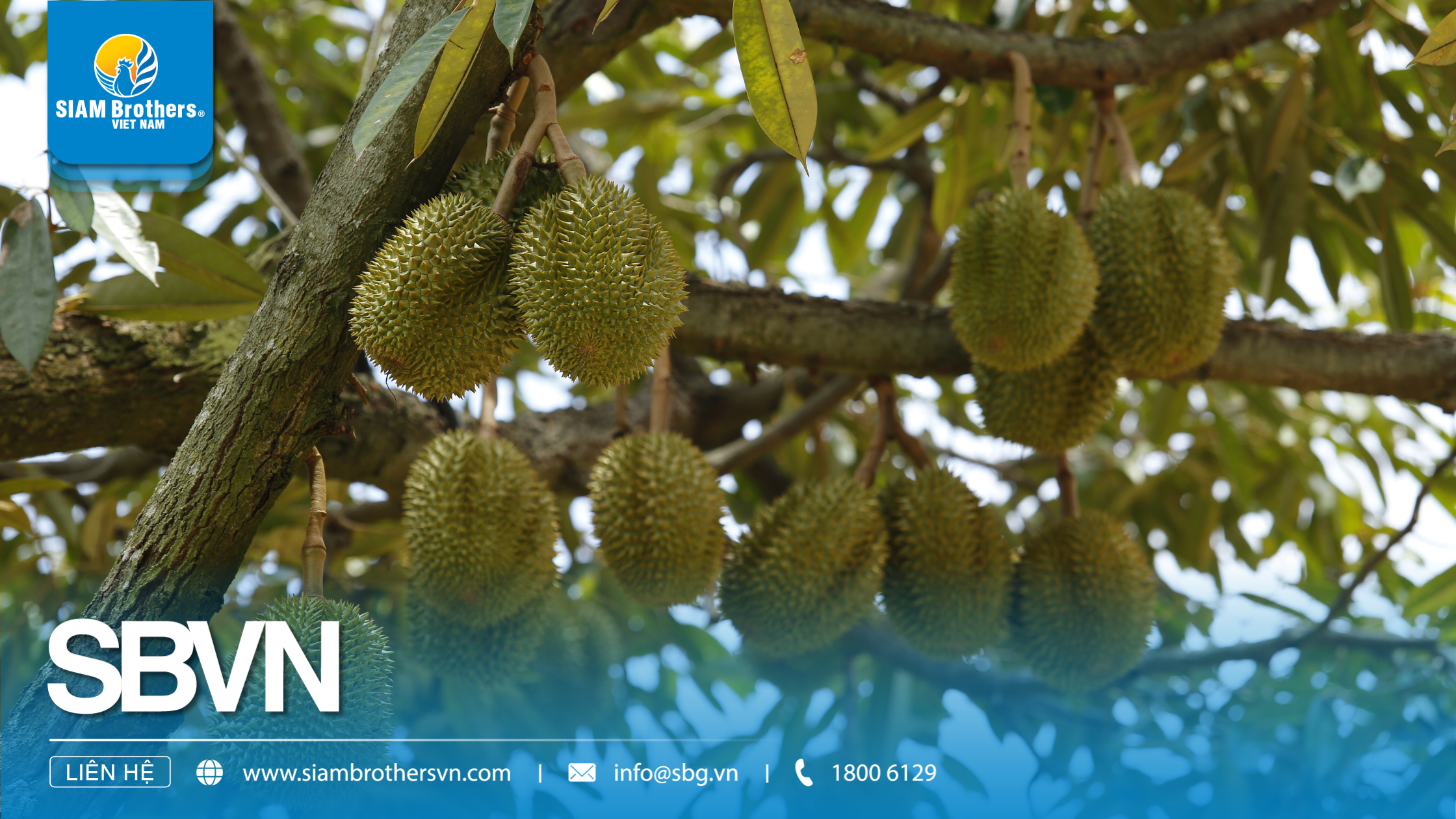
In Part 1 of this series, ropes and stakes were used to support banana plants carrying heavy bunches because banana plants have pseudostems and relatively shallow root systems. With durian trees, the components requiring protection are usually individual fruit-bearing branches or branches carrying an uneven load.
Young durian trees may also need stakes to reduce excessive movement in strong winds. However, a stake installed beside the trunk of a young tree serves a different purpose from a support pole placed beneath the branch of a mature tree.
Therefore, growers should not copy the exact rope and stake arrangement used for banana plants. To understand how to prevent durian branches from breaking, they must distinguish among three main components: the branch requiring support, the load-bearing anchor point and the rope connecting these two positions.
As durian fruit develops, the load on each branch changes continuously. A branch carrying several fruits, a cluster of fruits concentrated in one area or fruits located far from the trunk can create a greater bending force. When combined with rain and wind, this load may cause the branch to sway, sag or crack near its union with the trunk.
The first step in learning how to prevent durian branches from breaking is to observe how weight is distributed on each branch instead of considering only the total number of fruits on the tree. Two branches on the same tree may require different support arrangements because their diameters, growth angles, fruit positions and bark conditions are not identical.
Wind affects not only the fruit but also the entire canopy. After prolonged rainfall, soft or poorly drained soil may reduce root stability. Under these conditions, anchoring one branch may not adequately address the risk of trunk leaning or root movement.
Guidance on preparing fruit trees for storms, published by the Ha Tinh New Rural Development portal, recommends securing trunks or large branches in several directions and placing protective padding at contact points to reduce bark damage.
This guidance indicates that growers should consider the canopy, trunk, root system and orchard conditions together when deciding how to prevent durian branches from breaking.
A branch with cracks, pest damage, disease symptoms, damaged bark or a narrow union may no longer be suitable for carrying a heavy fruit load. A rope cannot restore the original strength of weakened wood. If it is tied directly over a damaged area, the concentrated force may cause the existing crack to spread.
Before installing a support system, growers should determine whether the branch remains strong enough to retain its fruit or whether the load should be reduced. A dangerously damaged branch may need to be pruned or assessed by an agricultural technician. Ropes should not be used to hold a branch that already shows signs of severe structural failure.
Growers should not wait until a branch has sagged considerably or developed visible cracks before taking action. The best time to implement a support system depends on fruit development, canopy structure, branch condition, weather forecasts and the orchard management schedule.
After determining the appropriate number of fruits to retain according to the tree’s condition and applicable technical guidance, growers should inspect how the remaining load is distributed across the branches.
This is an appropriate time to prepare ropes, support poles and anchor points before the branches become heavily loaded. Acting early allows suitable tying positions to be selected and support tension to be increased gradually.
If a branch has already sagged considerably, pulling it back abruptly may create excessive stress on the wood, bark and branch union. Early preparation is therefore one of the central principles in how to prevent durian branches from breaking safely.
Before the rainy or windy season, inspect long branches, branches extending beyond the main canopy, branches carrying several fruits and branches with a history of damage. Previously installed ropes, support poles and anchor points should also be checked.
A VOV report on durian cultivation in Dak Lak noted that growers reinforced branch-supporting poles, anchored trees and tied fruit-bearing branches before harvest.
This practical example shows that branch support is part of routine care for fruit-bearing durian trees, rather than merely an emergency response after damage has occurred.
Warning signs include rapid sagging, cracking sounds, unusual splits in the bark, widening branch unions, leaning support poles, slack ropes and slipping knots.
When any of these signs appears, access beneath the branch and fruit should be restricted while the components of the support system are assessed.
Do not jerk the rope or attempt to raise the branch in one sudden movement. Adjustments should be made gradually, with another person observing how the branch and surrounding canopy respond. Ensure that no people, tools or equipment remain beneath the loaded branch during the process.
Depending on the structure of the tree and orchard conditions, growers may connect a fruit-bearing branch to the main trunk or another strong load-bearing point, place a support pole beneath the branch, or combine both methods. No single arrangement is suitable for every tree.
The main trunk or a structural branch may be used as an anchor if it is healthy, free from cracks and suitably positioned in relation to the pulling direction.
The rope should support the fruit-bearing branch without creating unusual twisting forces on the trunk or pulling two weak branches toward each other.
When using an anchor point within the canopy, inspect both the attachment point on the loaded branch and the upper anchor point. A branch that appears strong may still be unsuitable if it is too small, grows at an unstable angle or is already carrying its own substantial fruit load.
Selecting a reliable anchor is fundamental to how to prevent durian branches from breaking with a rope-based system.
Support poles may be made from bamboo, wood, metal or another material suitable for orchard conditions. The upper end must provide stable contact with the branch, contain no sharp edges and remain in position when the branch moves.
Suitable padding may be added between the pole and the branch to reduce friction and protect the bark.
The base of the pole must rest on stable ground without obstructing irrigation lines, walkways or harvesting operations. A pole can sink or slip if the soil is soft, the pole is installed at an unsuitable angle or the contact point does not hold the branch securely.
A ground-based support system is effective only when both the upper contact point and the base of the pole remain stable.
For young durian trees, a stake is normally positioned close to the trunk to limit excessive movement in strong winds. The tie should be sufficiently wide or include suitable padding so it does not cut into the bark. It must also allow room for the trunk to develop.
The stake should be installed firmly while minimizing disturbance to the root zone.
This is an important distinction within the series. Stakes beside the trunk are generally more appropriate for young durian trees, while mature fruit-bearing trees usually require branch support, ground-based poles or anchor systems within the canopy.
The correct method must therefore change according to the age of the tree and the location of the load.
One attachment point may not be adequate for a long branch carrying several fruits. Growers may need to distribute the load through several ropes or combine a rope system with a support pole.
However, adding more ropes does not automatically make the system safer, particularly when they all transfer their loads to one weak anchor point.
When several ropes are installed, inspect the direction of force along each line. Prevent ropes from rubbing against each other or creating a tangled network within the canopy. Clear access must remain available for inspection, maintenance and harvesting.
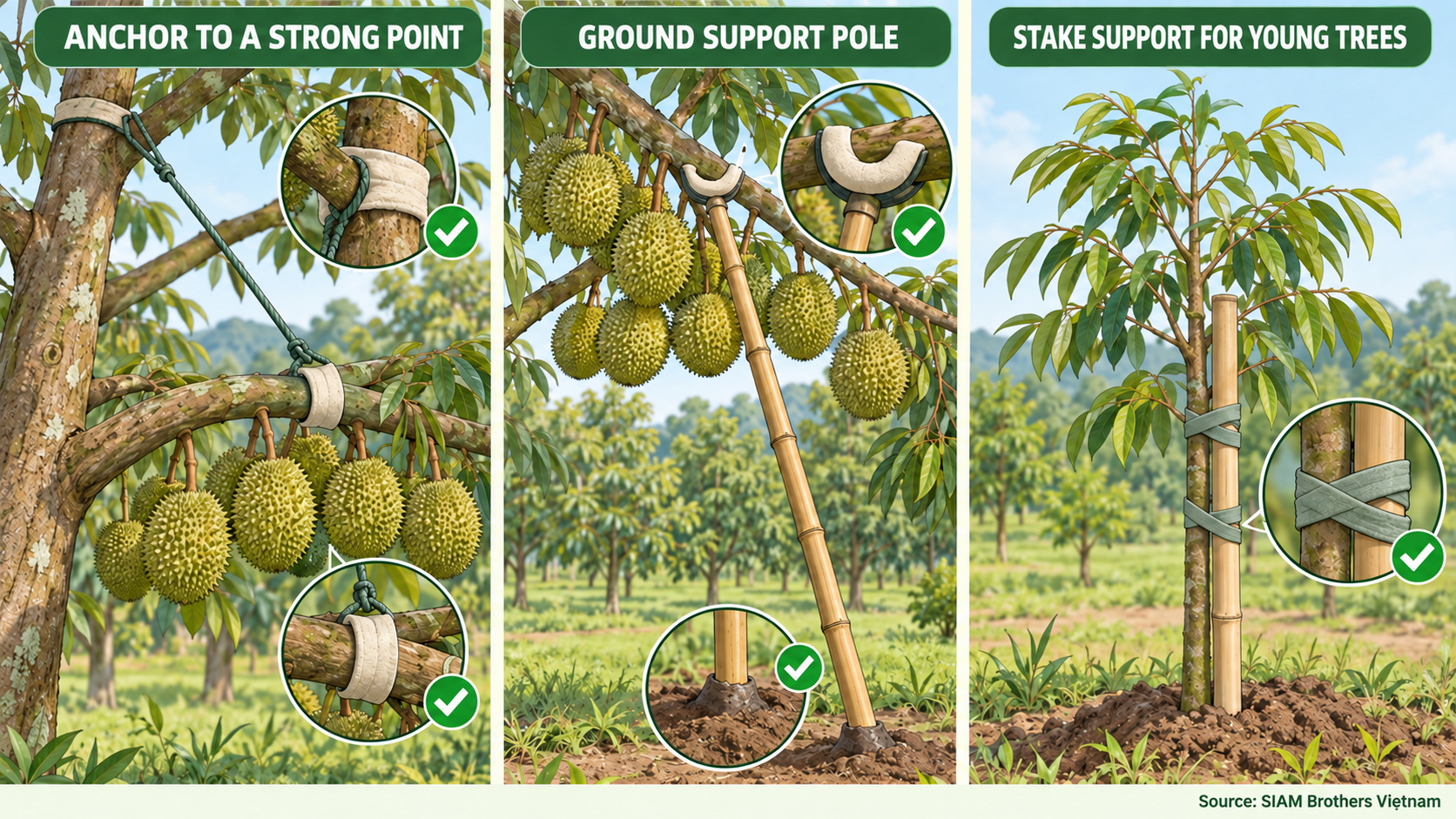
How to prevent durian branches from breaking with ropes, anchor points and support poles. - Source: SIAM Brothers Vietnam
The following five steps provide a basic framework for arranging a support system. Growers should adapt each step to the age of the tree, canopy structure, number of fruits, branch dimensions, soil conditions and prevailing wind direction.
If a branch is already cracked, the tree is leaning at its base or the orchard regularly experiences severe weather, consult a qualified agricultural technician before proceeding.
Inspect the entire canopy before installing any rope. Identify fruit-bearing branches, areas where fruit is concentrated, the direction in which each branch is sagging and the condition of its union with the trunk.
Check for cracks, pest or disease symptoms, damaged bark and branches crossing or pressing against each other.
A support system may be ineffective if it simply raises the tip of a branch without considering the main load-bearing area near the trunk. Determine whether the branch remains structurally suitable for reinforcement or whether the fruit load should be adjusted according to professional guidance.
If an anchor rope is used, select a sound section of the main trunk, a strong structural branch or an appropriate supporting structure with a suitable pulling direction.
If a support pole is used, check the strength of the pole, its upper contact surface and the ground beneath its base. Do not use small branches, cracked limbs or decayed poles as primary load-bearing points.
After arranging the components, apply a small amount of force to check for movement. The anchor must be capable of carrying the intended load without producing unusual displacement in other parts of the canopy.
Place the rope around a healthy section of the branch, away from wounds, weak unions and areas too close to the branch tip. Use a sufficiently wide loop or place suitable padding underneath the rope to distribute pressure across the bark.
The knot must remain secure while allowing adjustment. Do not let the loop cut into the branch as its diameter changes or as the fruit load increases. Secure loose rope ends so they do not become entangled with fruit, young shoots or access routes.
For additional practical guidance, growers can read SIAM Brothers Vietnam’s article on using durian branch support rope and tying it correctly to reduce branch breakage.
A rope that is too slack may provide insufficient support. A rope pulled too tightly may force the branch away from its natural position or concentrate excessive pressure at the knot.
Increase the tension gradually while observing the sag of the branch, the anchor point and the response of the surrounding canopy.
The purpose of the system is to share part of the load and limit excessive branch movement. It is not intended to pull a rigid branch into a completely different position.
After tensioning, inspect every location where the rope touches bark, the edge of a pole or another surface that could cause abrasion.
Immediately after installation, examine the system from several directions. The rope should not slip, the anchor point should not move and the support pole should not lean.
Keep the area beneath heavily loaded branches clear so workers can identify hazards during inspections.
As the fruit gains weight, and especially after rain or strong winds, reassess rope tension, loop position, pole stability and signs of abrasion. Learning how to prevent durian branches from breaking involves continuous monitoring. The work does not end after the first installation.
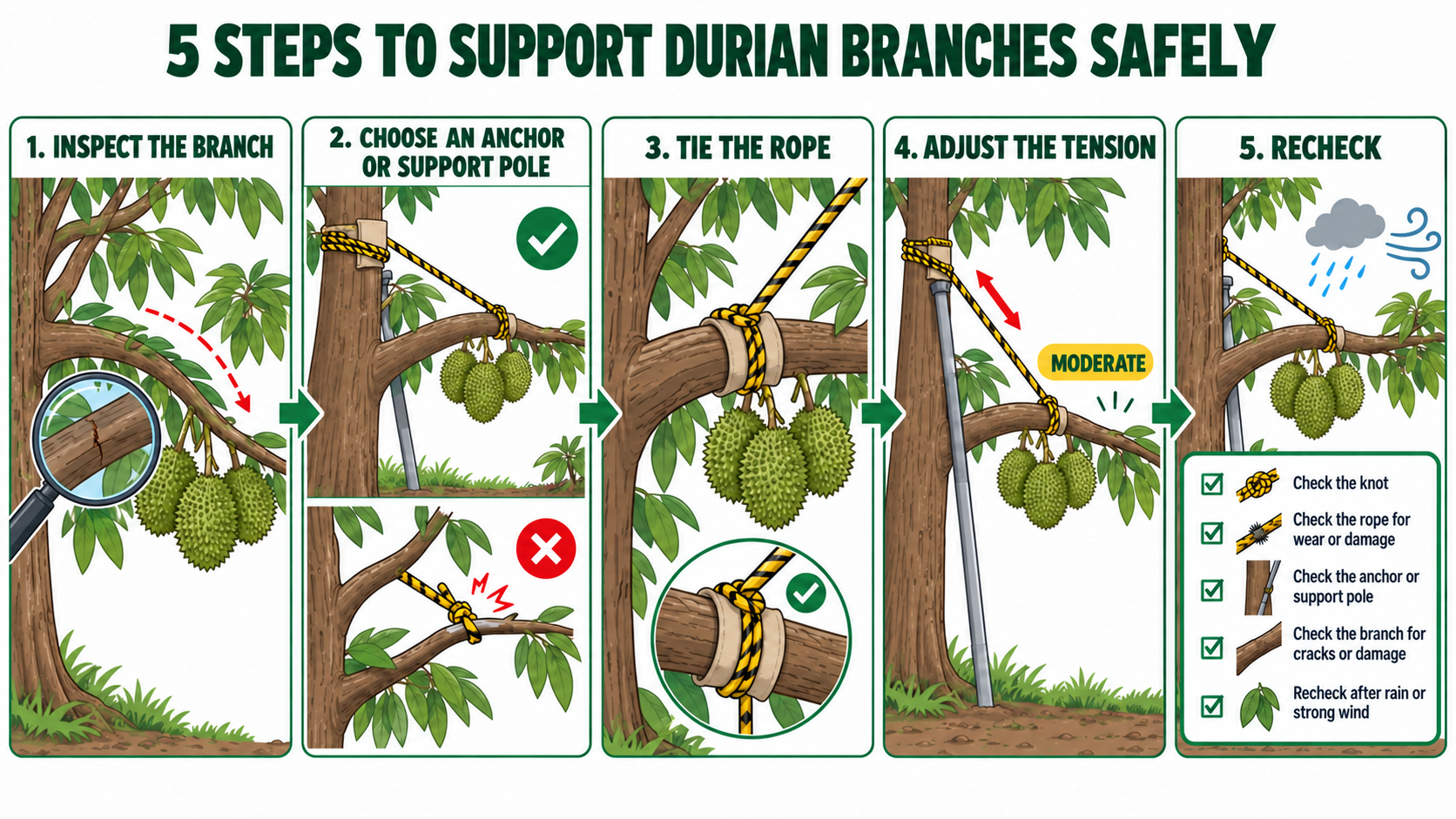
Five steps explaining how to prevent durian branches from breaking during fruit development - Source: SIAM Brothers Vietnam
After identifying the branch and a suitable load-bearing point, growers need a rope that is convenient for tying, anchoring and adjustment in orchard conditions.
AGR SEF is SIAM Brothers Vietnam’s new-generation PP anti-lodging support rope, developed for tying and anchoring plants, tensioning crop rows, connecting stakes and carrying out other agricultural reinforcement tasks.
When implementing a system to prevent durian branches from breaking, AGR SEF can connect a fruit-bearing branch to the trunk, a structural branch, a support pole or another suitable anchor.
However, the rope cannot create structural strength where the anchor is weak, the branch is damaged or the support pole is unstable.
Actual performance depends on the complete system, including the branch, anchor point, knot, pulling direction, tension and weather conditions. A rope remaining intact does not mean that a seriously damaged branch should continue carrying its existing load.
AGR SEF features a twisted PP construction, a recognizable yellow-and-black color scheme and a soft texture that facilitates tying, tensioning, anchoring and adjustment.
Its 520-meter roll format is suitable for preparing materials for multiple trees or larger cultivation areas. The product is designed to optimize cost per meter and reduce the time required to prepare support materials.
These characteristics can make the reinforcement process more convenient, but they do not replace the need to assess branch loads and attachment positions. Users should not apply excessive tension simply because the rope remains strong.
The yellow-and-black pattern makes rope lines easier to identify within the canopy during inspections. Ropes should be arranged neatly and kept away from fruit, young shoots and sharp edges.
Position knots where workers can safely reach and adjust them throughout the fruit development period.
Growers can also read What Is AGR SEF? A New-Generation PP Anti-Lodging Support Rope for Growers to learn more about the product’s role and intended applications.
An anchor point should be stronger and more stable than the component it supports. If the rope is attached to a small branch, a cracked limb or a pole standing in soft soil, the load may simply be transferred from one weak point to another.
Before increasing tension, inspect both ends of the rope. This is an essential rule in how to prevent durian branches from breaking with an anchor system.
A loop that is too tight or has a very small contact area may cut into the bark. Repeated friction during windy conditions can also damage the branch surface.
Use an appropriately sized loop, add protective padding when necessary and inspect the contact area regularly.
Do not place exposed wire or sharp-edged materials directly against the bark. If rigid components are included in the support system, protect the contact area and remove or adjust those components according to technical requirements.
Anchoring several branches to one point can create a concentrated load. If one rope becomes slack or one branch moves, the loads carried by the remaining rope lines may also change.
Growers must assess the strength of the anchor and distribute the ropes appropriately.
A reliable support system is not defined by the number of ropes used. Its effectiveness depends on suitable force directions and the stability of every connection point.
Growing fruit changes the load, while rain and wind can cause ropes to sag, knots to slip, poles to sink and contact points to wear.
Without regular inspections, a system that was suitable when installed may gradually become unstable.
After adverse weather, inspect the system visually from a safe position before approaching it. Do not stand directly beneath a heavily loaded branch or along the path of a rope under tension.
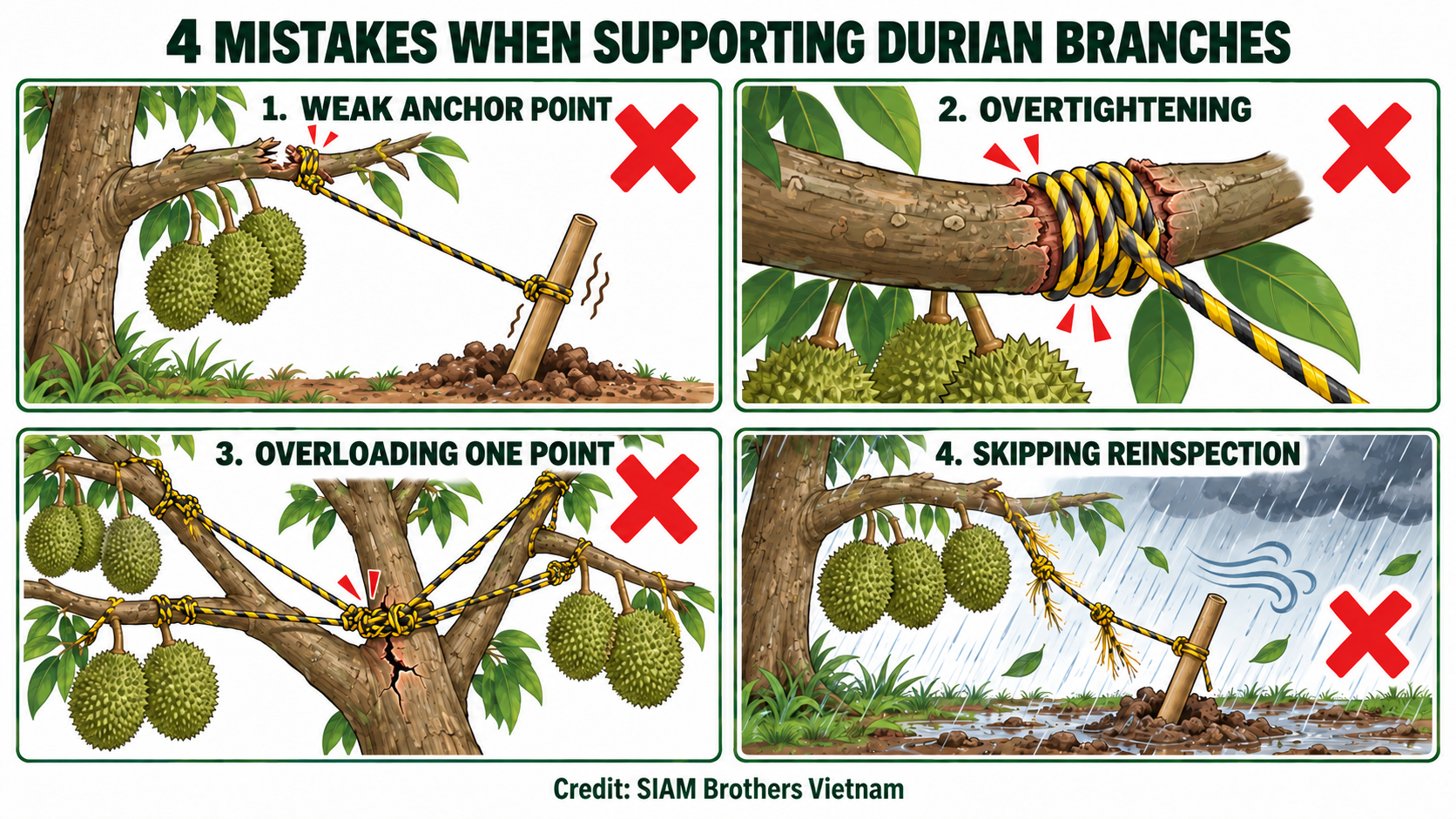
Common mistakes in how to prevent durian branches from breaking. - Source: SIAM Brothers Vietnam
To maintain the effectiveness of the support system, growers should check the following points:
Has the branch sagged further, cracked or developed new damage?
Has the fruit distribution created an excessive load on one side?
Has the anchor point on the trunk or structural branch moved or developed cracks?
Has the support pole decayed, bent, sunk or slipped from its contact point?
Has the rope become slack, frayed or worn at a contact area?
Has the knot slipped or has the rope loop started cutting into the bark?
Is the pulling direction still suitable as the fruit gains weight?
Do the ropes or support poles obstruct orchard care, harvesting or access routes?
These checks should continue throughout the fruit-bearing period, particularly before and after heavy rain or strong winds.
If a branch, anchor, support pole or rope shows signs of instability, adjust each component separately. Keep unauthorized people away from areas where fruit may fall or branches may break.
Knowing how to prevent durian branches from breaking requires the correct combination of a fruit-bearing branch, rope, anchor point or support pole.
Unlike banana plants, which often require support for the whole plant, mature durian trees need load distribution to be assessed for individual branches. Every connection point within the canopy must also be protected and regularly monitored.
Growers should install support systems early, choose strong load-bearing points, increase rope tension gradually and carry out inspections throughout fruit development. If a branch has a serious crack, the tree is leaning from its base or the orchard faces severe conditions, professional technical guidance should be sought instead of simply adding more ropes.
AGR SEF is SIAM Brothers Vietnam’s new-generation PP anti-lodging support rope. It can assist with tying branches, anchoring trees, tensioning crop rows and connecting load-bearing points. The product should be used as one component of a complete support system adapted to the tree structure and the actual conditions of each orchard.
Read more: What Is AGR SEF? A New-Generation PP Anti-Lodging Support Rope for Growers
Source: SIAM Brothers Vietnam
FAQ - Frequently Asked Questions
Q: Is supporting durian branches the same as preventing banana plants from lodging?
A: Not entirely. Banana plants normally require support for the pseudostem and the whole plant. Mature durian trees usually require ropes, support poles or several load-distribution points around individual fruit-bearing branches. Young durian trees may still be secured to stakes beside the trunk when actual conditions require it.
Q: Should durian branches be anchored to the trunk or supported with poles?
A: The appropriate option depends on the tree structure, branch position, fruit load and soil conditions. A branch may be anchored to a sound trunk or structural branch, supported from the ground or reinforced through a combination of both methods. Do not use a small branch, cracked limb or unchecked structure as the main load-bearing point.
Q: Can AGR SEF prevent durian branches from breaking by itself?
A: No. AGR SEF is a new-generation PP anti-lodging support rope that creates connections within a support system. Overall effectiveness also depends on branch health, anchor strength, support pole stability, knot selection, rope tension and the arrangement used in each orchard.
Contact us:
Address: 5th floor, VRG Building, 177 Hai Ba Trung Street, Vo Thi Sau Ward, Ho Chi Minh City, Vietnam
Tel: (+84) 28 38 912 889
Hotline: 1800 6129
Facebook: www.facebook.com/siambrothersvn
Email: info@sbg.vn
YouTube: youtube.com/@siambrothersvietnam1728
OA Zalo: zalo.me/1402339229697925373
App SBVN ID:
CHPlay: https://bit.ly/SBVNID-Android
Appstore: https://bit.ly/SBVNID-iOS








Specializing in Agricultural and Fisheries Products & Multipurpose Wire