
- 1800 6129

The purchase price represents only one part of the total cost of an oyster farming flotation system. Farmers must also consider site conditions, inspection frequency, replacement expenses, labour and end-of-life collection. To evaluate HDPE oyster farming floats across their full life cycle instead of comparing unit prices alone, let’s explore the subject with SIAM Brothers Vietnam...
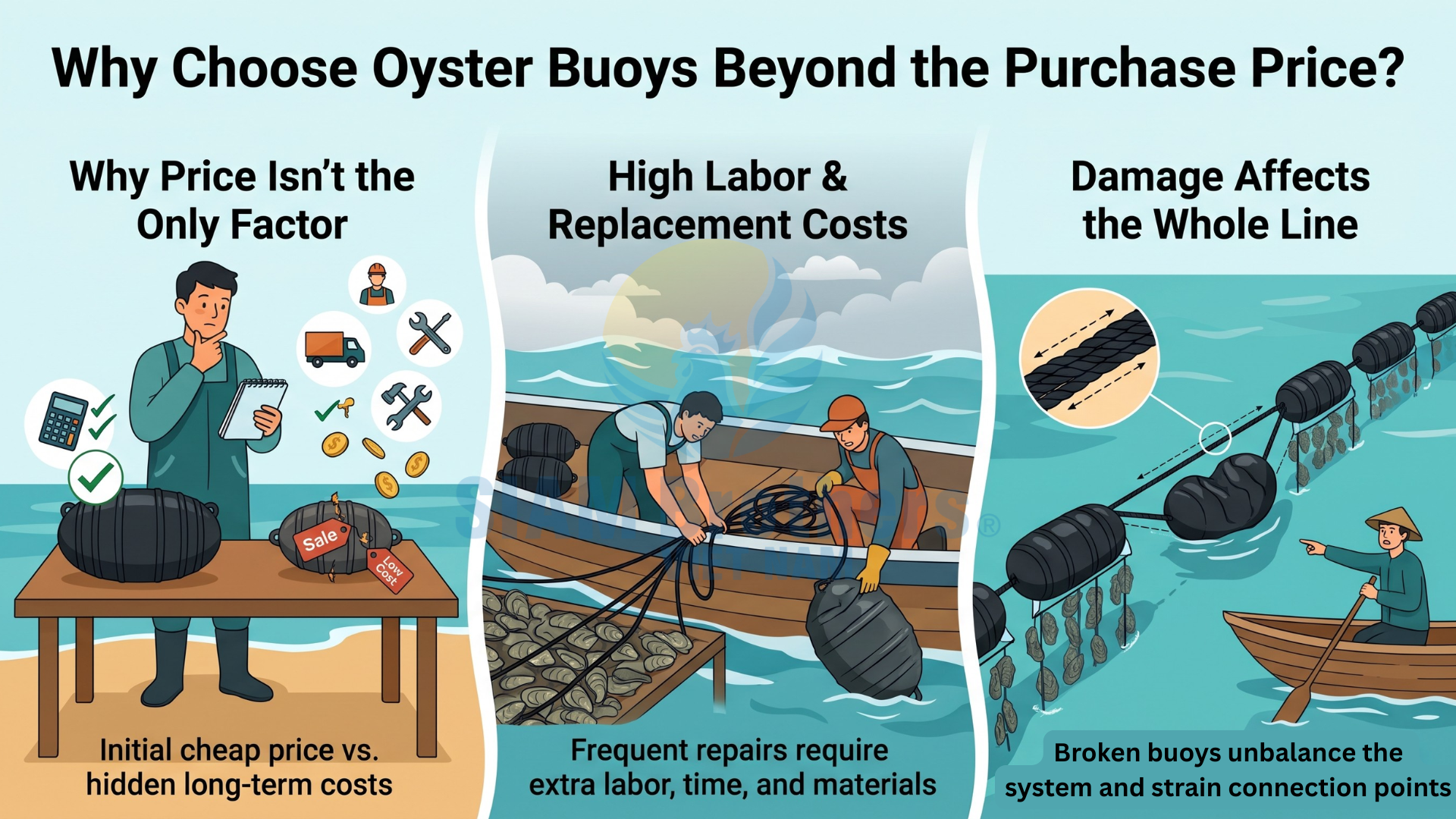
Why Should Oyster Floats Not Be Selected Based on Price Alone?- Source: SIAM Brothers Vietnam
Comparing unit prices is necessary when preparing a new oyster farming system. However, the product with the lowest initial price may not generate the lowest total cost over several farming cycles.
The total cost can include transportation, installation, inspection, replacement and the labour required to manage damaged components. When floats need to be replaced frequently, farmers may also spend additional time removing ropes, adjusting farming lines and collecting old materials.
A realistic budget should consider:
The required number of floats and connection accessories.
Transportation to the farming area.
Initial installation and adjustment.
Inspections after storms or adverse weather.
Replacement floats and ropes.
Labour for removal and reinstallation.
Operational interruptions during repairs.
Collection, transportation and end-of-life treatment.
This approach allows different options to be compared over the same period rather than by the price of each individual float.
Floats provide buoyancy and help maintain the position of a farming system on the water. If some floats become punctured, deformed or detached, buoyancy may be distributed unevenly. This can place additional stress on connection points, ropes and the anchoring system.
The severity of the effect depends on the farm configuration, number of floats, water conditions and how quickly the damage is detected. A damaged float does not automatically cause the loss of an entire farming cycle. Appropriate system design and regular inspections remain essential for identifying problems early.
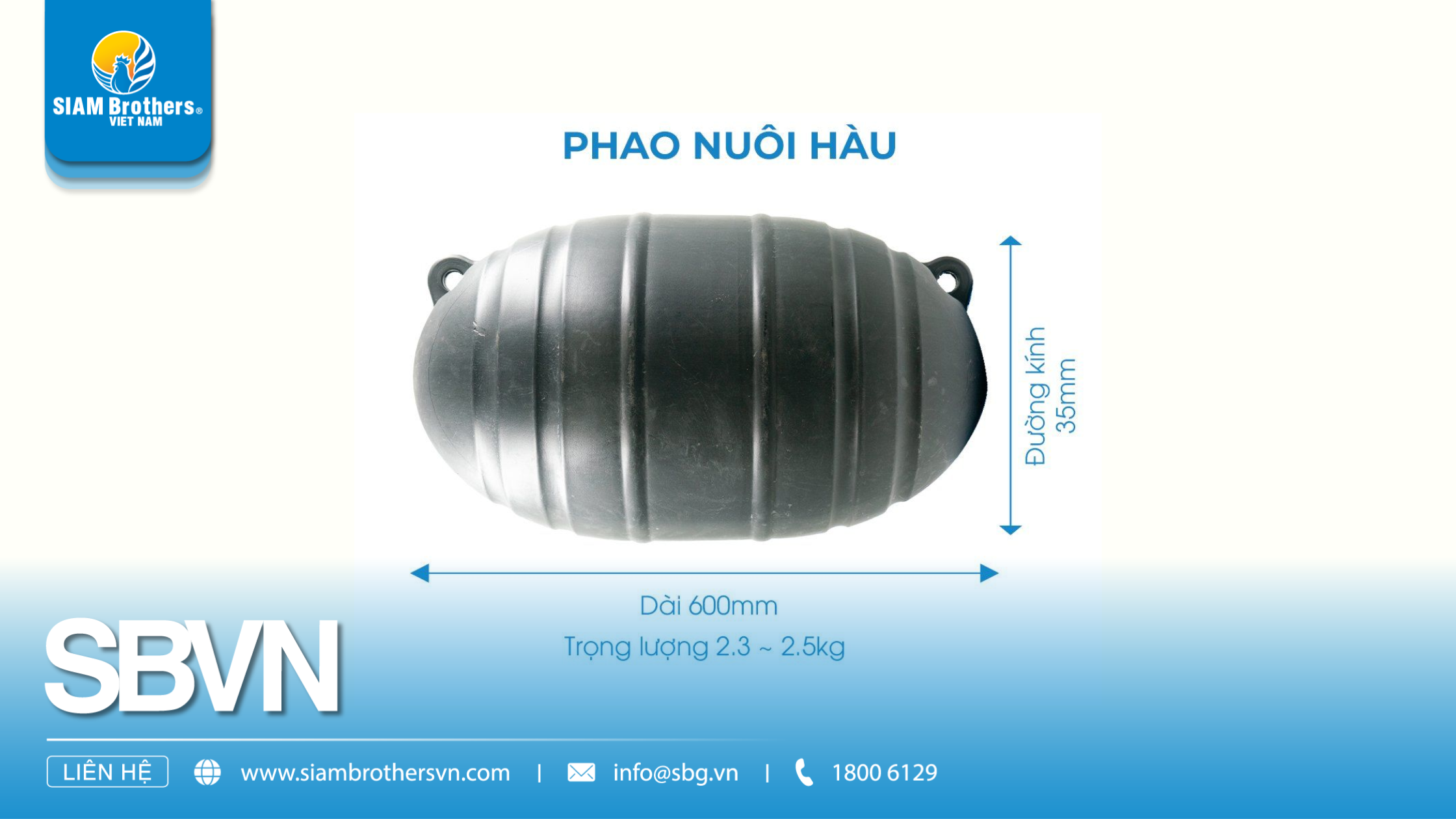
HDPE Oyster Floats - Source: SIAM Brothers Vietnam
SIAM Brothers Vietnam’s oyster farming float features a horizontal oval body, rounded tapered ends and raised ribs around the main body. Connection eyes are positioned at both ends for attachment to ropes or other parts of the farming system.
Its hollow, sealed structure creates buoyancy. The rounded form also supports installation along oyster farming lines on the water.
Depending on the farming configuration, oyster floats can:
Provide buoyancy for farming ropes or structures.
Help maintain the required position of the farming line.
Distribute buoyancy along the system.
Allow individual floats to be inspected and replaced.
Help operators identify the location of farming lines.
A float does not function independently. Overall performance also depends on rope type, float spacing, crop weight, connection methods and anchoring arrangements.
HDPE is used in many floating products because of its low water absorption and resistance to various conditions encountered in outdoor environments. UV stabilisers may also be added during manufacturing to support outdoor use.
However, not every HDPE product has the same service life or load capacity. Actual performance depends on the raw materials, additives, wall thickness, product design, manufacturing process and operating conditions.
HDPE is not immune to deterioration. Floats can still become scratched, deformed or damaged around connection eyes. Their surfaces may also age during prolonged outdoor use. For this reason, SIAM does not use absolute claims such as “microplastic-free,” “zero plastic waste” or “suitable for all weather conditions.”
Rather than asking exactly how many years a float will last, buyers should examine the product’s operating conditions and the total costs expected over a defined period.
Before selecting the number and arrangement of floats, collect information about:
The length and configuration of the farming line.
The method used to suspend ropes or oyster-growing materials.
The initial weight and estimated load as the oysters grow.
The preferred spacing between floats.
Water depth.
Current direction and tidal variation.
Exposure to waves, wind and passing vessels.
Existing ropes, accessories and anchoring systems.
A suitable configuration should provide the required buoyancy while allowing convenient inspection, harvesting and float replacement.
Farmers can organise costs into the following categories:
|
Cost category |
Items to consider |
|
Initial investment |
Floats, accessories, ropes, transportation and installation |
|
Operation |
Inspection, cleaning and system adjustment |
|
Replacement |
Damaged floats, connection points, ropes and installation labour |
|
Interruption |
Time required to repair or rearrange farming lines |
|
End of life |
Collection, transportation, reuse or transfer to an appropriate facility |
A specific cost-saving percentage should only be published when it is supported by operating data, a defined comparison period and a transparent calculation method. Without these details, claiming that a float always reduces costs by a fixed percentage may be misleading.
There is no single service-life figure that applies to every float and farming location. Product life may be affected by:
Sunlight intensity and UV exposure.
Waves, currents and tidal conditions.
Actual operating load.
Friction between floats, ropes and other structures.
Marine growth on the product surface.
Installation quality.
Inspection and maintenance frequency.
Investment performance should therefore be evaluated according to site-specific conditions rather than a general service-life claim.
Oyster farming floats differ in shape and connection method from multipurpose modular floats used for floating platforms and walkways. Buyers should clearly explain the intended application to avoid selecting the wrong product.
Reused plastic containers should not automatically be treated as aquaculture floats. They may not be designed for the required load, prolonged UV exposure or the connection arrangement of an outdoor farming system.
Before placing an order, buyers should confirm:
Manufacturing material.
Product shape and surface condition.
Dimensions, weight and reference buoyancy.
Position and design of the connection eyes.
Applications stated by the manufacturer.
Warranty terms.
Installation and maintenance guidance.
Compliance documentation required by local authorities, where applicable.
ISO 9001 certification relates to an organisation’s quality management system. It does not automatically mean that every product complies with all relevant technical regulations or product standards.
The farming system should be inspected periodically and after severe weather. Operators should check for cracks, punctures, deformation, damaged connection eyes and rope wear at points of contact with the floats.
Floats that are no longer suitable for use should be removed, collected and transferred to an appropriate receiving facility. Damaged floats should not be left near the farming area or allowed to drift into surrounding waters.
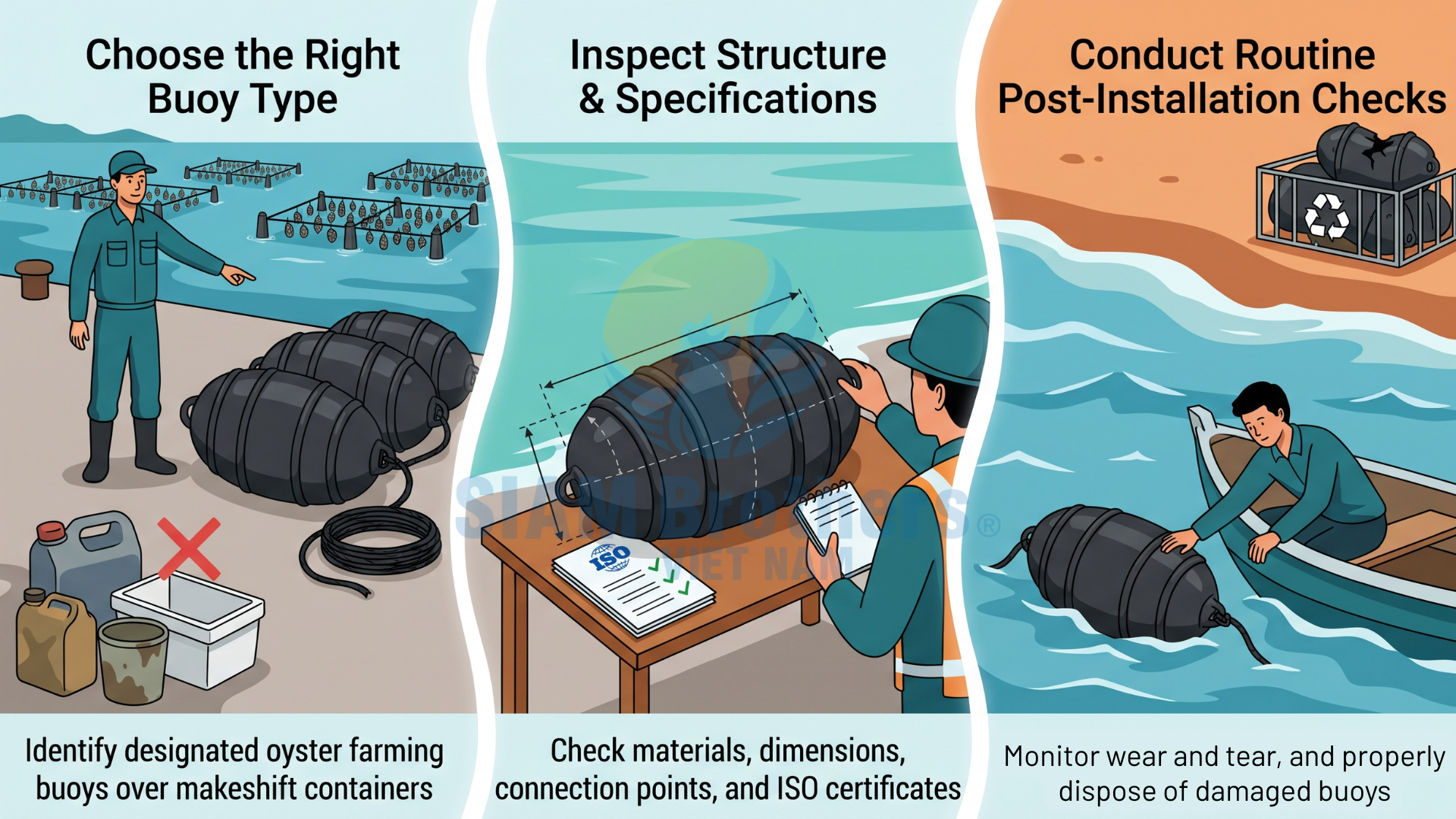
What Should Be Checked Before Buying HDPE Oyster Floats? - Source: SIAM Brothers Vietnam
To recommend a suitable product and quantity, SIAM Brothers Vietnam needs to understand the actual farming conditions. Customers should provide:
Location and site photographs.
Planned farming scale.
Farming-line or raft configuration.
Existing rope and anchoring systems.
Number of floats required or replaced.
Wave, wind, current and tidal conditions.
Current operational problems.
A quotation should clearly state the product type, quantity, accessories, transportation, technical support and warranty terms. This enables customers to compare total costs rather than individual product prices alone.
HDPE oyster farming floats can be a suitable option when their configuration matches the expected load, farming structure and water conditions. Investment performance should not be evaluated solely through the purchase price or a general service-life figure. Farmers should consider the complete process, including selection, installation, inspection, replacement and end-of-life collection.
Read more: SIAM Brothers Vietnam HDPE Oyster Farming Float
Source: SIAM Brothers Vietnam
European Commission. (n.d.). Non-EU countries authorised establishments. Directorate-General for Health and Food Safety.
International Organization for Standardization. (n.d.). ISO 9001 and quality management systems.
People’s Committee of Quang Ninh Province. (2020). Local technical regulation on floating materials used in brackish and marine aquaculture in Quang Ninh Province (QCĐP 08:2020/QN).
Q: Are HDPE floats suitable for every oyster farming system?
A: A single configuration should not be assumed to suit every farm. Selection depends on the expected load, farming-line arrangement, water conditions and anchoring system.
Q: How long do HDPE oyster farming floats last?
A: Service life depends on product construction, UV exposure, load, waves, friction, installation quality and inspection practices.
Q: Are HDPE floats completely free from microplastic generation?
A: This absolute claim should not be made. Plastic materials can still age or experience surface wear, so floats must be inspected, replaced and collected appropriately.
Q: What information is required to request a quotation?
A: Customers should provide the farming location, scale, line configuration, required quantity, water conditions and site photographs so that SIAM can recommend an appropriate option.
Contact us:
Address: 5th floor, VRG Building, 177 Hai Ba Trung Street, Vo Thi Sau Ward, Ho Chi Minh City, Vietnam
Tel: (+84) 28 38 912 889
Hotline: 1800 6129
Facebook: www.facebook.com/siambrothersvn
Email: info@sbg.vn
YouTube: youtube.com/@siambrothersvietnam1728
OA Zalo: zalo.me/1402339229697925373
App SBVN ID:
CHPlay: https://bit.ly/SBVNID-Android
Appstore: https://bit.ly/SBVNID-iOS






Specializing in Agricultural and Fisheries Products & Multipurpose Wire