
- 1800 6129

Learning how to prevent banana plants from toppling is especially important when the plants begin carrying fruit or before periods of heavy rain and strong wind. An effective support system requires more than rope. It also needs firm stakes, suitable attachment points, and balanced tension. To understand the role of each component and arrange the system according to actual field conditions, let SIAM Brothers Vietnam guide you through the key steps.

Source: SIAM Brothers Vietnam
A banana plant has a pseudostem formed by tightly overlapping leaf sheaths. While the plant is young, the weight of the pseudostem and leaf canopy is relatively balanced. Once the fruit bunch develops, additional weight is concentrated on one side, making the plant more likely to lean. Strong wind and soft soil after rain can further reduce its stability.
For this reason, determining how to prevent banana plants from toppling requires an assessment of the plant’s leaning direction, fruit-bunch position, root condition, and surrounding soil.
Technical information from Tamil Nadu Agricultural University notes that banana plants have relatively shallow roots and may require support from bamboo or casuarina stakes during windy periods. The National Horticulture Board of India also refers to bamboo or eucalyptus stakes for supporting banana plants.
These references show that the stake is an important load-bearing component, while the rope creates a connection between the plant, stake, or another suitable anchor point.
A banana bunch develops primarily on one side of the plant, so its weight is not distributed evenly around the pseudostem. As the bunch becomes heavier, the plant may lean in the same direction. If strong wind adds lateral force, the pseudostem may bend, split, or become uprooted.
An appropriate method for how to prevent banana plants from toppling should create support against the direction of lean. Tying rope around the plant without considering the load direction may provide little support or create unwanted twisting force.
Soil condition is one of the first factors to inspect after prolonged rain. Saturated soil may lose some of its ability to hold the root system firmly. Plants at the edge of a field, at the end of a row, or in areas directly exposed to prevailing winds may face greater pressure.
If a stake is driven too shallowly or positioned in weak soil, the plant and stake may lean together. The effectiveness of a support system therefore cannot be judged only by how strong the banana support rope feels.
When considering how to prevent banana plants from toppling, timing matters. If a plant has already developed a severe lean, pulling it upright may apply sudden force to the pseudostem, root zone, and fruit bunch.
Growers should inspect the field regularly to identify plants with heavy bunches, visibly leaning pseudostems, unstable root zones, or direct exposure to wind. Preparing stakes and rope before unfavorable weather arrives makes installation safer and easier.
Not every plant in a field needs to be tied in exactly the same way. Growers should also avoid waiting until a severe-weather warning is issued before beginning reinforcement.
The best timing for how to prevent banana plants from toppling depends on the banana variety, plant height, root condition, bunch size, prevailing wind direction, and soil characteristics.
As the fruit bunch begins to develop, growers should observe the direction in which the pseudostem is leaning. An early approach to how to prevent banana plants from toppling makes it easier to determine the stake position, direction of rope tension, and area requiring support.
If the plant remains stable, the system only needs to provide sufficient support. Excessive tension may pull the plant unnaturally in the opposite direction and transfer unnecessary load to the stake.
Banana rows located around the field boundary or in exposed areas should be inspected early. Older stakes may have decayed, loosened, or tilted. Previously installed rope may be worn at knots and contact points.
An effective plan for how to prevent banana plants from toppling should therefore include inspection of existing systems, not only the installation of new rope around recently fruiting plants.
Warning signs include rapid leaning, cracks or movement in the soil around the base, loose stakes, slack rope, and slipping knots. At this stage, how to prevent banana plants from toppling depends on reducing pressure where possible, inspecting every support point, and making gradual adjustments.
Do not jerk the rope in an attempt to straighten the plant immediately. A sudden pull may damage the pseudostem or cause further movement around the roots.
Source: SIAM Brothers Vietnam
Stakes used when applying how to prevent banana plants from toppling may be made from bamboo, wood, or another material suitable for the field conditions. They may be positioned beside individual plants or installed as anchor points in a connected row system.
The stakes must be sufficiently strong, free from severe decay or cracking, and firmly installed in stable soil. Selection should be based on plant height, bunch weight, soil conditions, and the direction of prevailing winds.
Bamboo and wooden stakes are practical options for many banana farms. When planning how to prevent banana plants from toppling, growers should inspect the entire stake, especially the section that will enter the soil and any area that will rest against the plant.
A stake that is rotten, hollow, cracked, or too small in relation to the plant should not serve as the main load-bearing point. Any edge that may touch the pseudostem should be smoothed or covered. Where a stake directly supports the plant, a suitable padding layer may help reduce rubbing and concentrated pressure.
The end of the stake should not be positioned where it could damage the bunch, bunch stalk, or important leaf sheaths.
For an individual plant, a stake may be positioned to resist the direction in which the plant is leaning. In row cultivation, growers may connect several stakes with rope to create a shared support line.
However, if an end stake is weak, forces from multiple plants may be transferred to the same point and destabilize the entire section. A row-based method for how to prevent banana plants from toppling must therefore include careful checks of the first stake, last stake, and all intermediate supports.
There is no universal stake spacing or number of rope lines suitable for every field. The layout must reflect planting density, topography, soil strength, plant condition, and actual loading.
Stake placement directly affects system performance. Stakes should be positioned without causing unnecessary root damage or obstructing walkways, irrigation, routine care, and harvesting activities.
The anchor point must be located in sufficiently stable soil. If the ground is saturated or eroded, simply driving the same stake deeper may not solve the problem. The grower may need to select another position or add an appropriate reinforcement method.
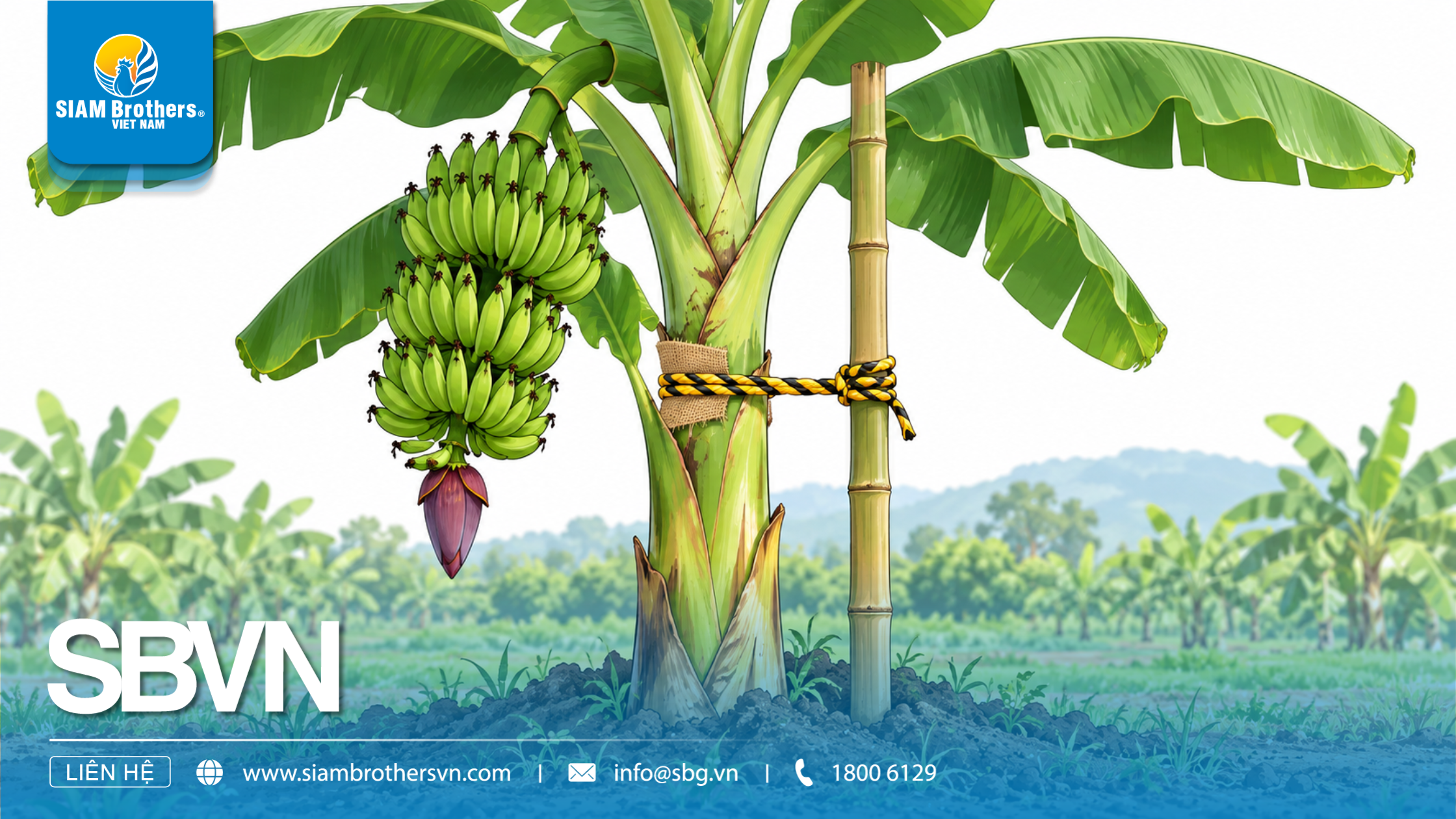
Illustration of a bamboo or wooden stake positioned beside a fruiting banana plant - Source: SIAM Brothers Vietnam
The following process presents five basic steps for arranging rope and stakes. Growers should adapt the method to the banana variety, plant age, bunch weight, wind direction, soil condition, and local farming experience.
For large fields or locations regularly exposed to strong winds, additional guidance from an agricultural technician should be considered.
Begin by examining the angle of the pseudostem, position of the bunch, condition of the base, and usual wind direction. In practice, how to prevent banana plants from toppling starts with determining which way the existing force is pulling the plant so the stake or anchor can provide support from an appropriate direction.
The system will be less effective if the rope pulls in the same direction as the lean or applies a twisting force to the pseudostem.
Do not examine only the upper part of the plant. Check the soil around the base, visible cracks, damaged leaf sheaths, and general plant stability. If the root zone has already shifted considerably, make gradual corrections rather than attempting to pull the plant upright in one movement.
Choose a stake that is not rotten, cracked, or excessively bent. Position it carefully to avoid significant root damage and keep it clear of routine access routes.
After installation, apply moderate hand pressure to check whether the stake moves. When using a connected row system, inspect every intermediate stake and reinforce the end points carefully. The load from several plants should never depend entirely on one weak support.
The stake forms the structural support. Even a good rope cannot compensate for an unstable anchor point.
The attachment point should provide effective support without tightening around the bunch or another vulnerable area. Where the rope contacts the pseudostem, use a sufficiently wide loop or suitable padding to distribute pressure.
Continue checking the contact point after installation because the pseudostem and fruit bunch will keep developing. When learning how to prevent banana plants from toppling, growers should remember that a knot needs to remain secure under load while still allowing adjustment.
Avoid leaving long rope ends across walkways. If several rope lines are installed, arrange them neatly so they do not obstruct irrigation, weeding, spraying, or harvesting.
Correct tension is essential. A rope that is too slack may not support the plant when it leans. A rope pulled too tightly may press into the pseudostem, pull the plant in the opposite direction, or place continuous unnecessary load on the stake.
Increase tension gradually while observing the plant. Stop when the system provides a stable supporting point without visibly distorting the plant.
After tensioning, check whether the rope rubs against a sharp stake edge, the pseudostem, or another abrasive surface. Concentrated friction can accelerate wear. The rope should also be positioned at a height that does not create a hazard for workers or equipment moving through the field.
Once installation is complete, view the support system from several directions. The stake should remain stable, the knot should not slip, and the plant should not be pulled into an abnormal position.
After heavy rain or strong wind, inspect stake settlement, rope tension, knots, and areas of contact with the pseudostem. The process of how to prevent banana plants from toppling does not end with the first installation.
As the bunch becomes heavier and soil moisture changes, the force applied to the system also changes. Periodic adjustment helps growers identify weak stakes, worn rope, and attachment points that are beginning to tighten around the plant.
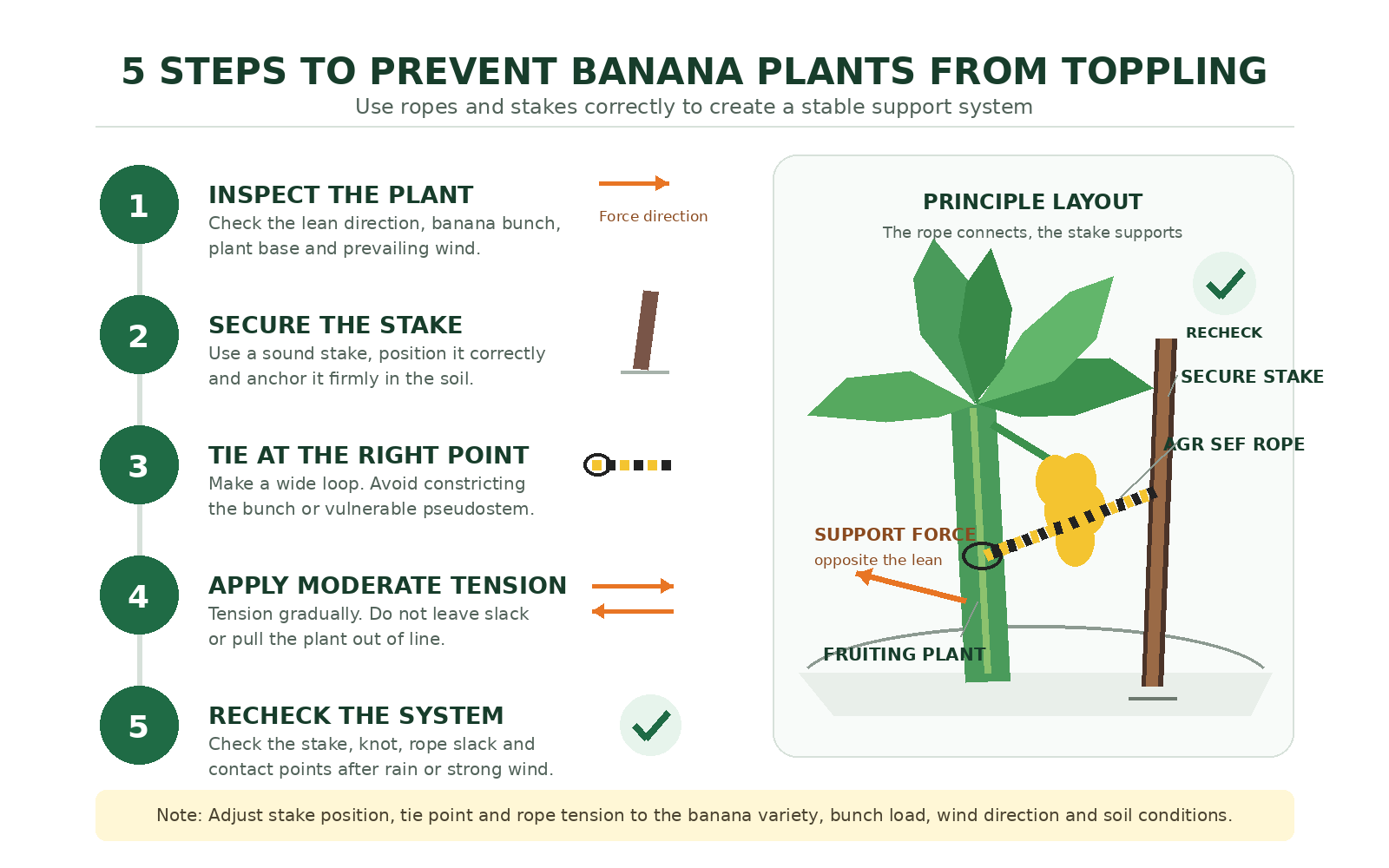
A five-step diagram showing plant inspection, stake installation, rope attachment, tension adjustment, and final inspection - Source: SIAM Brothers Vietnam
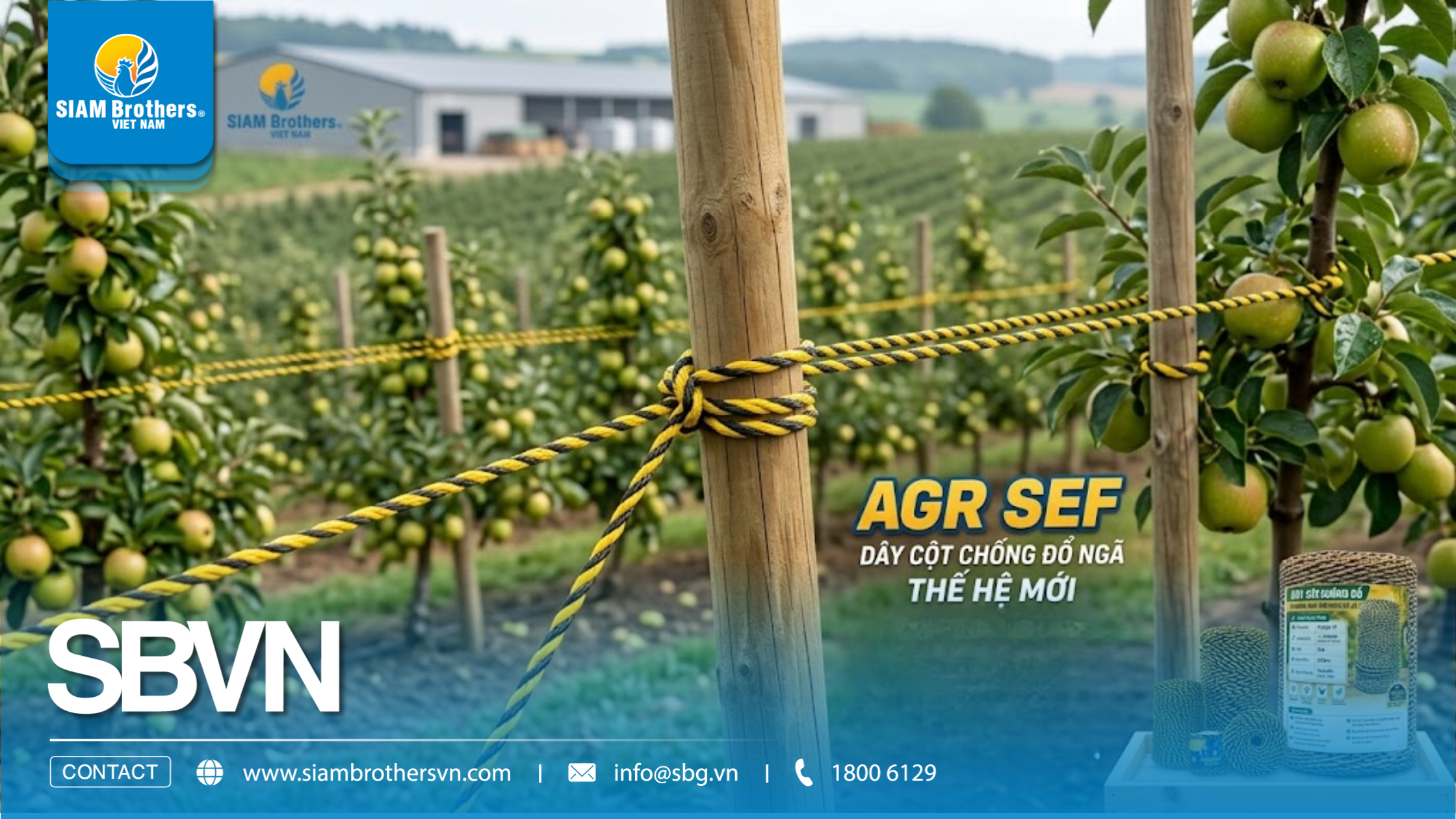
After determining the correct stake, anchor point, and support direction, growers need rope that is convenient to tie, tension, and adjust in the field. AGR SEF is SIAM Brothers Vietnam’s new-generation PP anti-lodging rope, developed for tying plants, anchoring plants, tensioning rows, connecting stakes, and reinforcing crop-support systems.
When applying how to prevent banana plants from toppling, AGR SEF connects the plant to a stake, one stake to another, or the plant to another suitable anchor point. The rope does not create an independent load-bearing system by itself.
Actual performance also depends on stake strength, anchor position, knot selection, rope tension, soil condition, and plant condition. Communicating this role clearly helps growers avoid the belief that tying rope around a plant is sufficient.
Even strong rope may fail to protect a plant when combined with a decayed stake, weak anchor point, or unsuitable knot.
AGR SEF has a twisted PP construction, a visible yellow-and-black color combination, and a flexible structure that supports tying, tensioning, anchoring, and adjustment. For growers considering how to prevent banana plants from toppling across larger areas, its 520-meter coil format is suitable when preparing materials for multiple plants.
The product is designed to help optimize rope cost per meter and reduce the time required to prepare materials. These features make field work more convenient, but users must still select an appropriate layout.
Do not apply excessive tension simply because the rope remains strong. The same knot, rope tension, or number of support lines should not automatically be used in every banana field.
When AGR SEF is used in a row-based system, rope lines should be tidy, easy to see, and clear of walkways. The yellow-and-black color helps workers identify the rope during routine care and inspection.
Loose ends should be secured neatly, while knots should remain accessible for later adjustment.
Growers can learn more through the article What Is AGR SEF? A New-Generation PP Anti-Lodging Rope for Growers.
This is a common mistake when implementing how to prevent banana plants from toppling. A rotten stake, shallow installation, or weak soil can make the entire support point unstable.
Before replacing the rope or increasing tension, inspect the stake and the soil around its base.
A banana pseudostem should not be treated like a rigid woody trunk. A loop that is too tight or a narrow contact point may create concentrated pressure and damage the plant.
Allow room for adjustment, inspect the attachment regularly, and add suitable padding when necessary.
A plant in the center of the field, a plant at the end of a row, a plant with a heavy bunch, and a plant with unstable roots do not experience the same forces.
The method for how to prevent banana plants from toppling must be adapted to each situation. Copying the same stake spacing or rope tension across an entire field may leave some plants supported from the wrong direction.
Inspection is an essential part of how to prevent banana plants from toppling. Rain may soften the soil and cause stakes to settle, while wind may loosen knots or increase abrasion.
After unfavorable weather, growers should walk along each row, visually inspect the system, and correct abnormal conditions early.
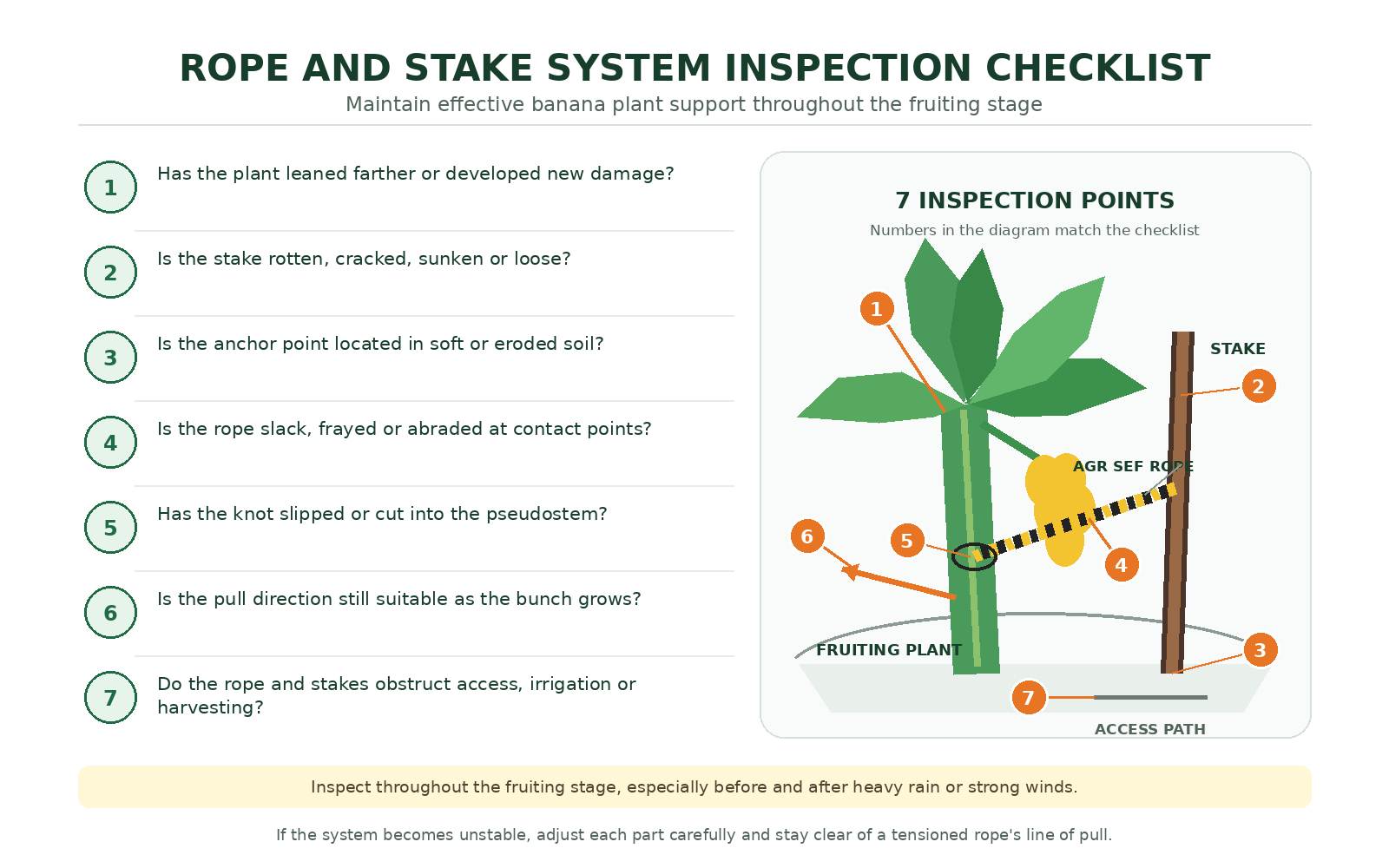
Rope-and-Stake System Inspection Checklist - Source: SIAM Brothers Vietnam
To maintain the effectiveness of the support system, growers applying how to prevent banana plants from toppling can check the following points:
Has the plant leaned further or developed new damage?
Is the stake rotten, cracked, sunken, or loose?
Is the anchor point located in soft or eroded soil?
Is the rope slack, frayed, or worn at a contact point?
Has the knot slipped or tightened deeply into the pseudostem?
Does the pulling direction remain appropriate as the bunch grows?
Do the rope and stakes obstruct walking, irrigation, plant care, or harvesting?
Inspections should continue throughout the fruiting period, especially before and after heavy rain or strong winds. If the plant, stake, or rope shows signs of instability, adjust each part gradually and avoid standing in the direction of a tensioned line.
An effective method for how to prevent banana plants from toppling requires the plant, stake, rope, and anchor point to work together. The stake creates structural support, the rope provides the connection, and the layout determines how forces are distributed.
In summary, how to prevent banana plants from toppling involves installing support early, applying moderate tension, and inspecting the system regularly instead of waiting until a plant develops a severe lean.
AGR SEF is SIAM Brothers Vietnam’s new-generation PP anti-lodging rope for tying plants, anchoring plants, tensioning rows, and connecting stakes. However, it should be used as one component of a complete support system suited to the soil, crop, and actual cultivation method.
Read more: What Is AGR SEF? A New-Generation PP Anti-Lodging Rope for Growers
Source: SIAM Brothers Vietnam
FAQ - Frequently Asked Questions
Q: Does preventing banana plants from toppling always require both rope and stakes?
A: It depends on the field layout and plant condition, but the rope needs a sufficiently strong connection or anchor point to work effectively. When stakes are used, growers should check the stake material, soil stability, and direction of support before applying tension.
Q: Should growers use bamboo or wooden stakes for banana plants?
A: Both bamboo and wooden stakes can be suitable if they meet actual field requirements. A stake should not be rotten, cracked, or too weak. It must be installed in stable soil and should not have sharp edges that could damage the plant or rope.
Q: Can AGR SEF completely replace banana support stakes?
A: No. AGR SEF is a new-generation PP anti-lodging rope that creates connections within a plant-support system. Performance still depends on the stakes, anchor points, knots, rope tension, soil conditions, and layout used in each field.
Contact us:
Address: 5th floor, VRG Building, 177 Hai Ba Trung Street, Vo Thi Sau Ward, Ho Chi Minh City, Vietnam
Tel: (+84) 28 38 912 889
Hotline: 1800 6129
Facebook: www.facebook.com/siambrothersvn
Email: info@sbg.vn
YouTube: youtube.com/@siambrothersvietnam1728
OA Zalo: zalo.me/1402339229697925373
App SBVN ID:
CHPlay: https://bit.ly/SBVNID-Android
Appstore: https://bit.ly/SBVNID-iOS








Specializing in Agricultural and Fisheries Products & Multipurpose Wire