
- 1800 6129

PTT marine engine oil plays an important role in lubricating, controlling soot deposits, and protecting the internal components of diesel engines. However, engine oil gradually deteriorates after extended exposure to high temperatures, heavy loads, and contaminants during operation.
Changing the oil too late may increase friction, cause abnormal engine temperatures, or lead to deposit formation. In contrast, choosing the correct lubricant and regularly monitoring its condition can help vessel owners manage maintenance proactively and reduce the risk of engine problems while operating at sea.
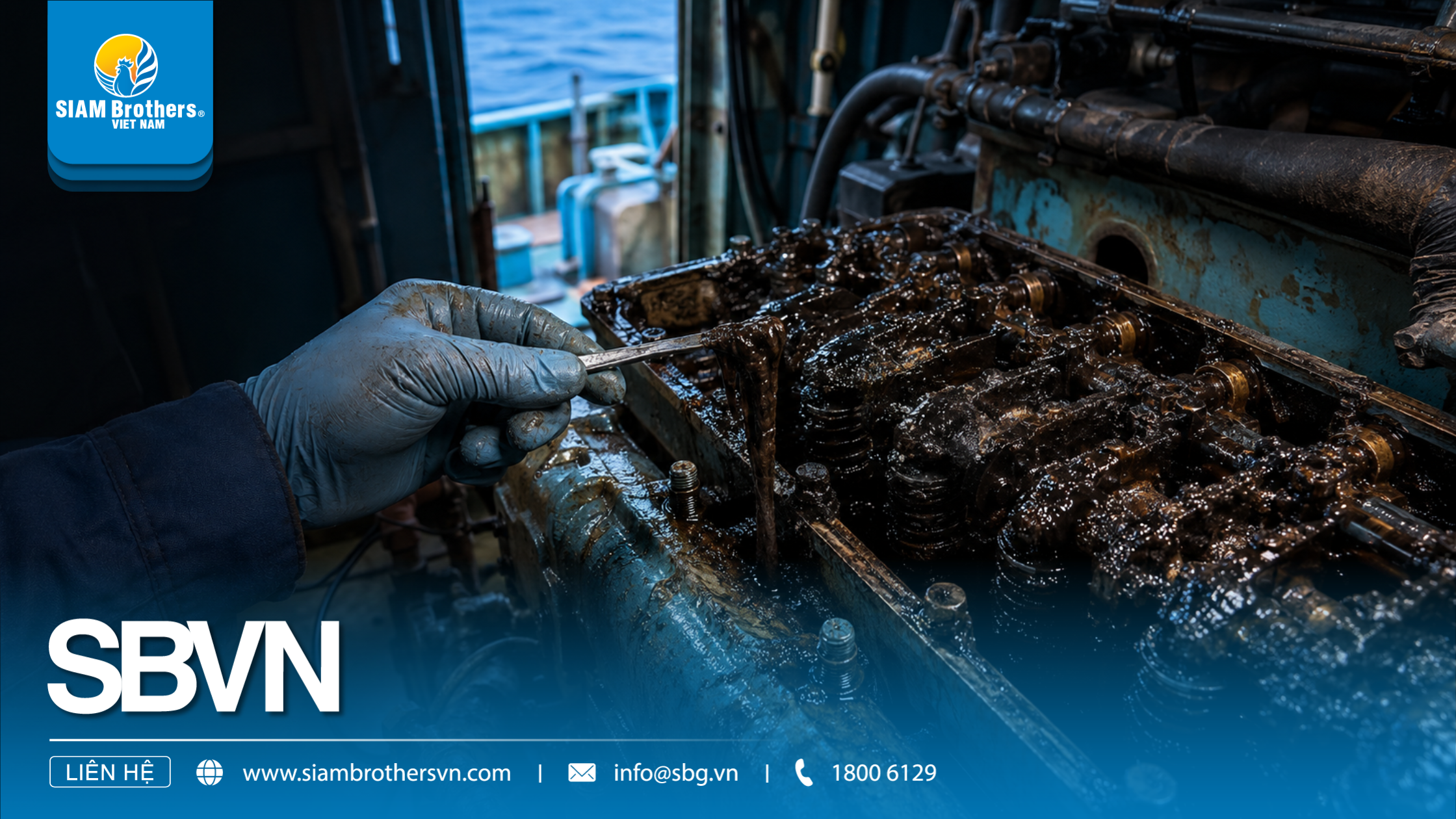
Illustration
Fishing vessel engines often operate continuously for many hours, carry heavy loads, and work in environments with high humidity and salt exposure. Engine oil not only creates a protective lubricating film but also helps disperse soot, control deposits, and protect metal surfaces.
According to Caterpillar, oil analysis can detect excessively high or low viscosity, oxidation, soot, fuel dilution, water, and coolant contamination. These factors can all affect the oil’s ability to protect the engine.
Vessel owners should therefore not assess engine oil based only on its color. Oil level, consistency, odor, operating hours, and the actual performance of the engine should also be considered.
Diesel engine oil turning dark after a period of use is not necessarily an abnormal sign. The black color may appear because the oil is collecting and dispersing soot produced during combustion.
However, if the oil also becomes excessively thick or contains sludge, hardened deposits, or visible particles, it may have undergone severe oxidation or accumulated too much soot. Caterpillar notes that excessively high viscosity can prevent the oil from lubricating effectively, while soot can clog filters and increase engine wear.
In this situation, the engine oil, oil filter, and cause of excessive soot formation should be inspected before the vessel continues operating for extended periods.
If the oil level on the dipstick repeatedly falls below the recommended range shortly after being topped up, the engine may be consuming or leaking oil.
Possible causes include damaged gaskets, seals, oil lines, or piston rings. The selected oil may also be unsuitable for the engine’s current level of wear. Vessel owners should inspect possible leakage points, observe exhaust smoke, and monitor how much oil needs to be added during each voyage.
Continually topping up the oil without identifying the cause may conceal mechanical damage that is developing inside the engine.
A burnt smell may indicate that the oil has been exposed to excessive heat or has oxidized. Meanwhile, oil that appears milky, emulsified, or foamy may indicate that water or coolant has entered the lubrication system.
Water contamination can cause corrosion, sludge formation, and reduced protection of metal surfaces. Fuel entering the oil can reduce its viscosity and make the protective oil film too thin.
When these signs appear, vessel owners should not simply replace the oil and continue operating the engine. The cooling system, fuel injectors, gaskets, and other related components should also be inspected.
Deteriorated engine oil can increase friction between moving components, causing the engine to run hotter and produce unusual sounds. In some cases, the engine may feel sluggish, accelerate slowly, or lose power when the vessel is under load.
However, these symptoms are not caused exclusively by engine oil. Problems with the fuel system, cooling system, air filter, or mechanical components may produce similar effects.
Vessel owners should therefore check the oil level, oil pressure, oil filter, engine temperature, and maintenance history instead of assuming that an oil change alone will solve the problem.
Even when the engine does not show any unusual symptoms, the engine oil and oil filter should still be replaced according to the engine manufacturer’s maintenance schedule.
The same oil change interval should not be applied to every fishing vessel. The appropriate maintenance interval depends on engine design, fuel quality, operating load, engine temperature, engine condition, and the performance level of the lubricant being used.
Cummins also notes that oil change schedules should be determined according to the specific engine application and maintenance instructions. Some engines may have intervals of 250, 500, or 700 operating hours, but these figures should not be treated as universal standards for all marine engines.
The safest approach is to consider three main factors:
The recommendations provided in the engine manufacturer’s manual.
The actual operating hours recorded in the maintenance log.
The condition of the engine oil, oil filter, and oil analysis results when necessary.
For vessels that regularly operate under heavy loads, run continuously, or use fuel of inconsistent quality, the oil change interval may need to be shortened.
Product claims such as “up to” 600, 800, or 1,000 operating hours should be understood as reference capabilities under suitable conditions. They are not mandatory oil change intervals for every engine.
Extended oil change intervals should only be considered when they are supported by the engine manufacturer and reliable oil condition data.
Caterpillar recommends combining high-quality oil and filters with a regular oil analysis program when assessing or safely extending oil change intervals.
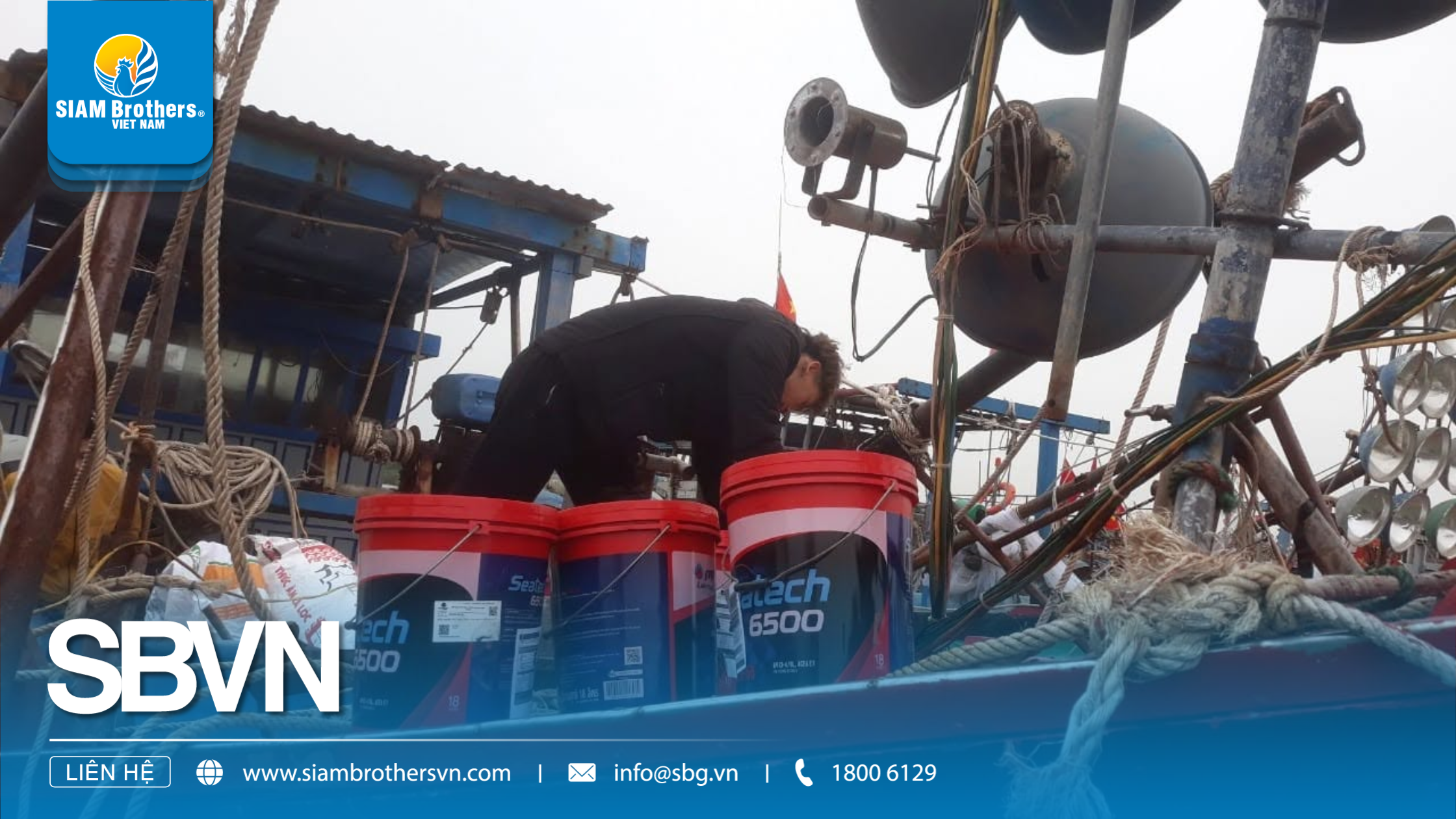
Source: SIAM Brothers Vietnam
PTT is Thailand’s national energy group, operating across industries such as petroleum, petrochemicals, and energy. PTT Lubricants is the group’s specialist lubricant business, developing and manufacturing products for industrial, transportation, and marine applications.
PTT lubricants are developed to meet international standards such as API and SAE and are distributed across many Asian markets. The PTT Seatech range is specifically designed for fishing vessels and marine transport engines operating under heavy loads and demanding environmental conditions.
The first factor to check is the API performance level required by the engine manufacturer. Engine oil should not be selected solely based on price or how thick it feels.
The PTT Seatech products currently distributed by SIAM Brothers Vietnam include:
|
Product |
Performance level |
Viscosity grades |
Suitable engine types |
|
PTT Seatech 5000 |
API CF-4 |
SAE 15W-40, 20W-50 |
Small to medium fishing vessels with high-speed diesel engines |
|
PTT Seatech 6000 |
API CH-4 |
SAE 15W-40, 20W-50 |
Direct-injection and high-speed diesel engines |
|
PTT Seatech 6500 |
API CI-4 |
SAE 15W-40, 20W-50 |
Modern engines, Common Rail systems, and high-power engines |
The performance levels and viscosity grades above are published on the product pages of SIAM Brothers Vietnam.
PTT Seatech 5000, 6000, and 6500 are available in SAE 15W-40 and SAE 20W-50 viscosity grades. PTT Lubricants also describes Seatech 6000 as a high-performance diesel engine oil developed for fishing vessels using high-speed diesel engines.
The appropriate viscosity grade should be selected according to the engine manufacturer’s instructions:
SAE 15W-40: Suitable for many diesel engines that remain in good mechanical condition and require faster oil circulation during startup.
SAE 20W-50: Maintains a higher viscosity when the engine reaches operating temperature and may be considered for heavy-load conditions or engines with a certain level of wear.
Vessel owners should not automatically switch to a thicker oil to address excessive oil consumption. This may only provide a temporary effect and cannot replace an inspection of the underlying mechanical problem.
PTT Seatech 5000 is suitable for small to medium fishing vessels equipped with high-speed diesel engines. The product is designed to support soot control, engine cleanliness, and deposit prevention.
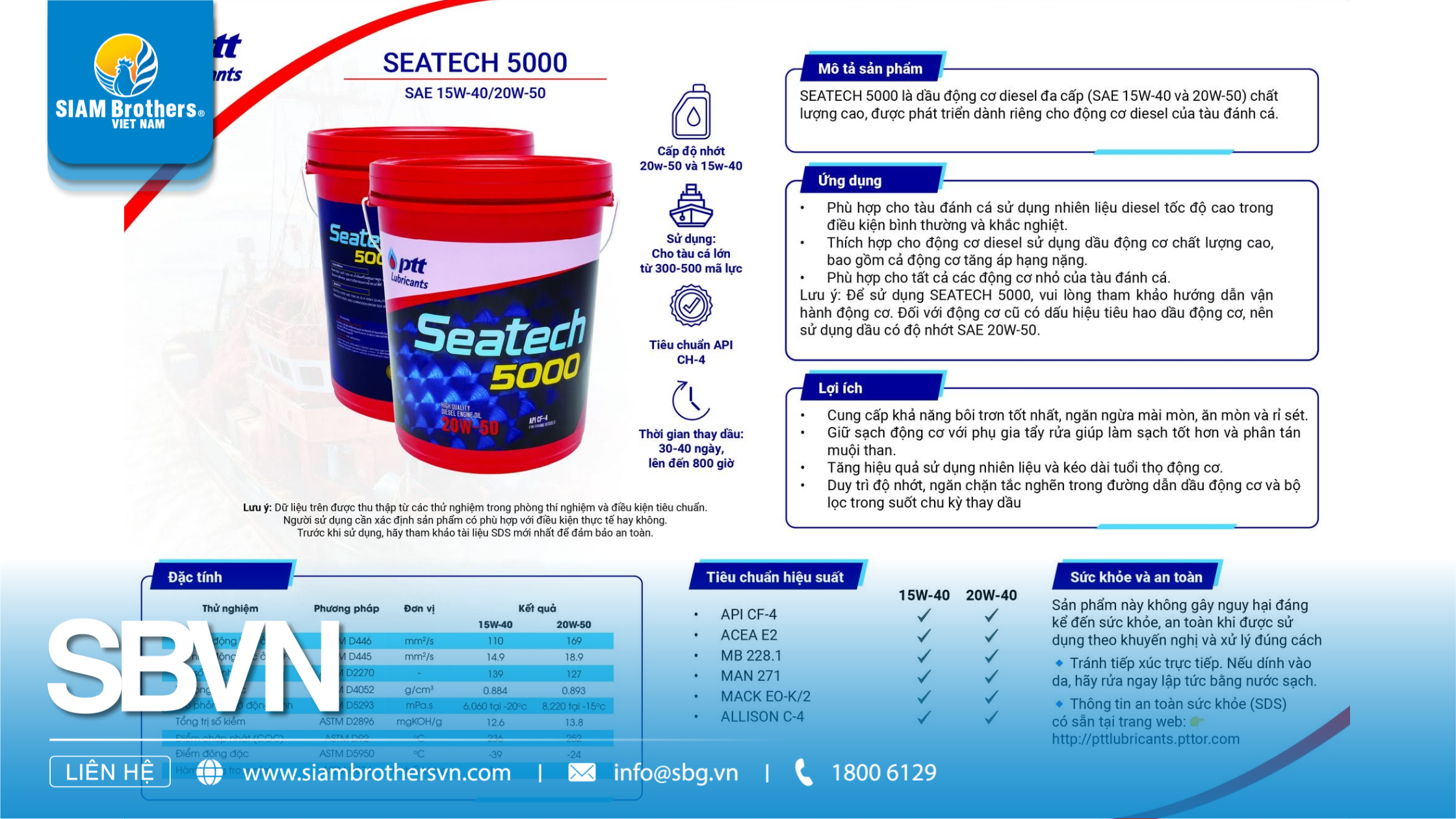
PTT Seatech 5000 - Source: SIAM Brothers Vietnam
PTT Seatech 6000 is suitable for high-speed diesel engines and direct fuel injection systems. It meets the API CH-4 performance level and focuses on controlling oxidation, soot, rust, and corrosion.
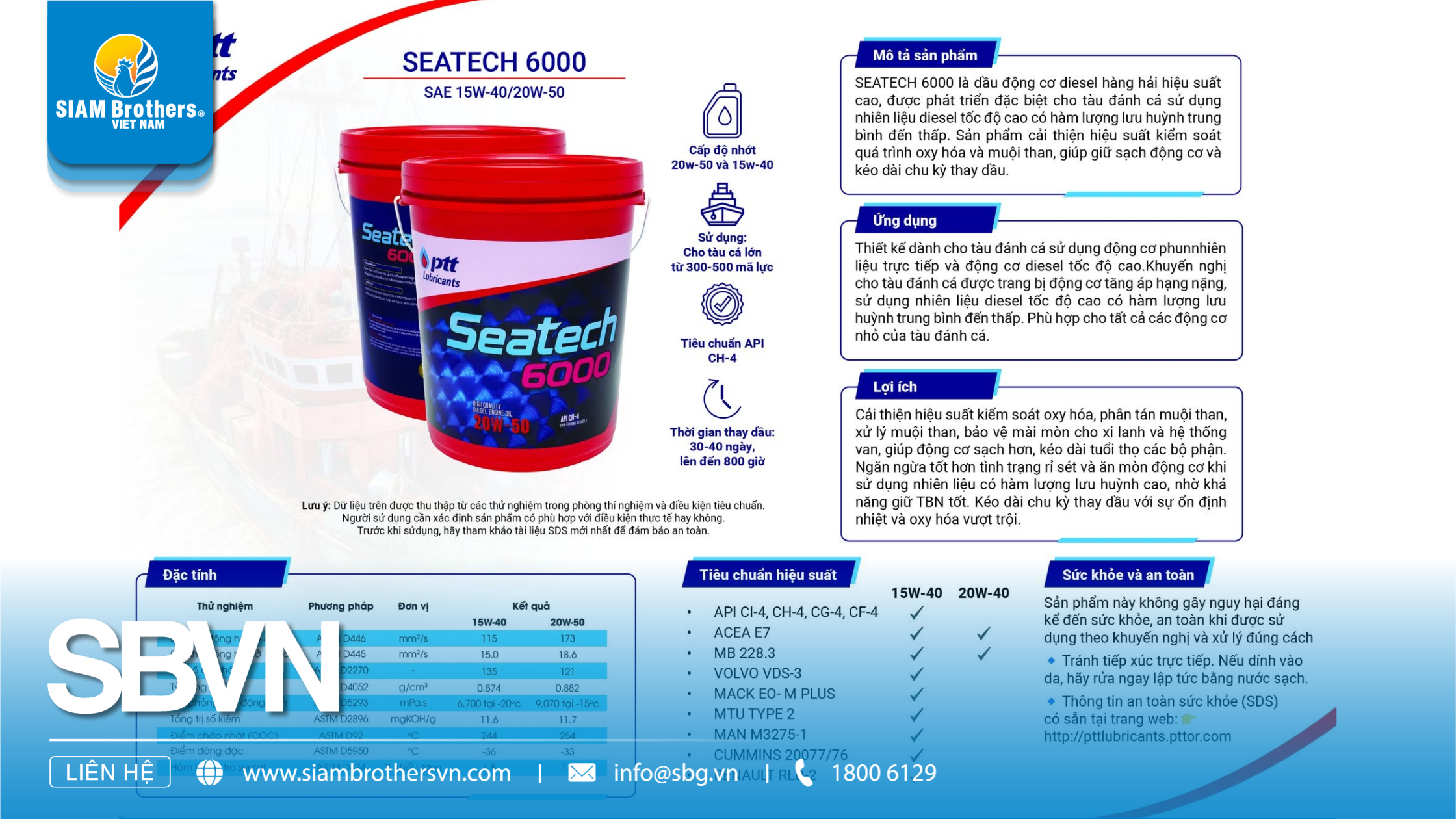
PTT Seatech 6000 - Source: SIAM Brothers Vietnam
PTT Seatech 6500 is intended for high-power engines and Common Rail technology requiring the API CI-4 performance level. It is designed for extended operation, high-temperature conditions, and greater deposit-control requirements.
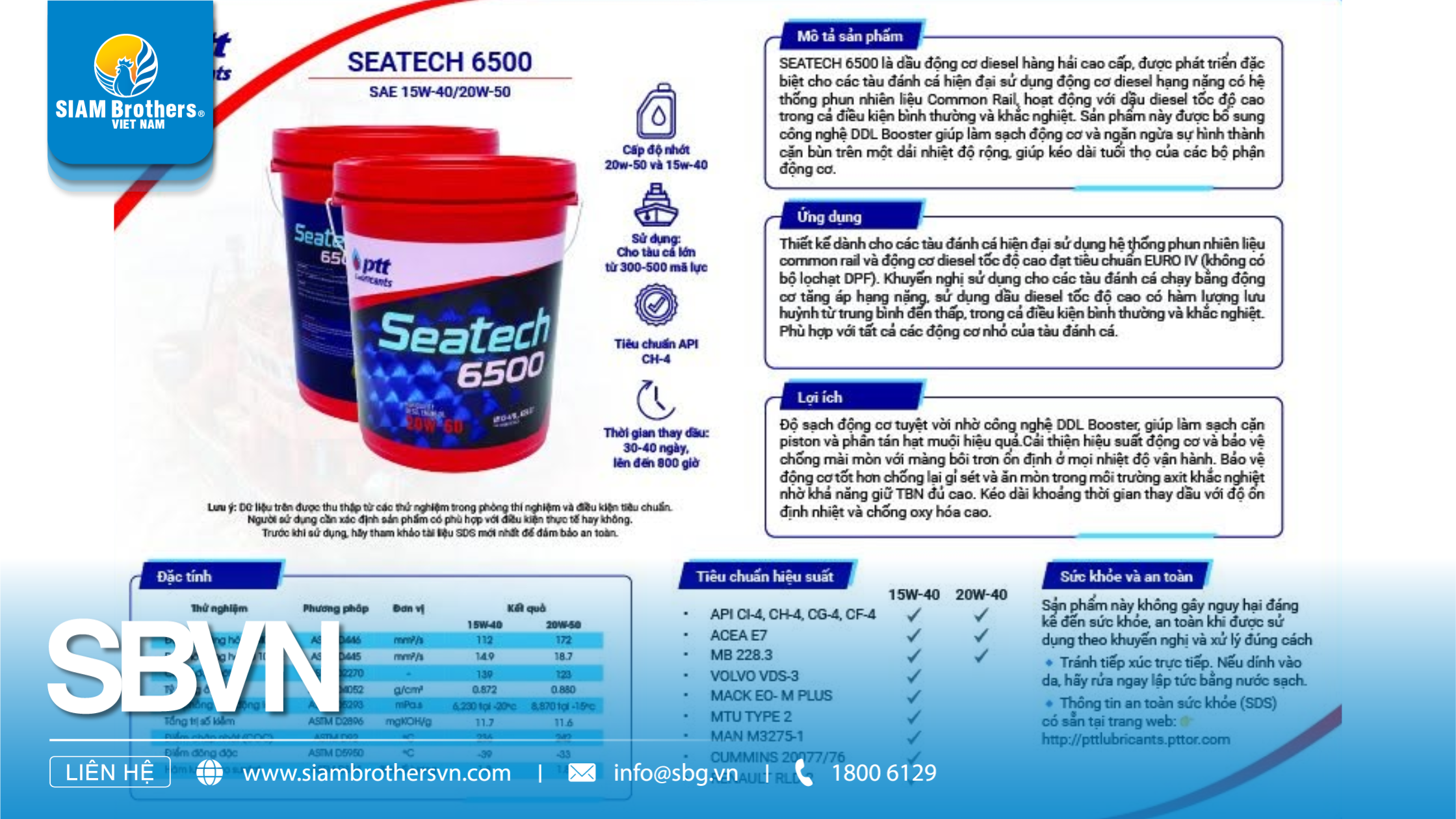
PTT Seatech 6500 - Source: SIAM Brothers Vietnam
Before each maintenance session, vessel owners should complete the following steps:
Record the engine’s total operating hours.
Check the oil level while the vessel is positioned evenly.
Observe the oil’s color, consistency, odor, and visible deposits.
Inspect oil lines, gaskets, seals, and possible leakage points.
Replace the oil filter according to the manufacturer’s instructions.
Avoid mixing lubricants with different or incompatible specifications.
Record the oil product, viscosity grade, and replacement date.
Recheck the oil level and inspect for leaks after starting the engine.
If the oil contains metal particles, water, coolant, or a strong fuel smell, a technical inspection or laboratory oil analysis should be considered. Oil analysis can help identify wear metals, contaminants, and abnormal changes occurring inside the engine.
Recognizing the signs that an oil change is required can help vessel owners reduce the risk of overheating, increased friction, and engine damage during fishing operations. However, black engine oil does not always mean that the lubricant has failed.
The oil’s viscosity, deposits, odor, consumption rate, operating hours, and engine performance should all be evaluated together.
When selecting PTT marine engine oil, priority should be given to the required API performance level, SAE viscosity grade, engine technology, and the engine manufacturer’s recommendations.
SIAM Brothers Vietnam currently distributes PTT Seatech 5000, 6000, and 6500, providing suitable options for small and medium fishing vessels as well as high-power Common Rail marine engines.
Read more: PTT Seatech Lubricant 5000, 6000, 6500 – The Ultimate Choice for Marine Engines
Source: SIAM Brothers Vietnam
FAQ – Frequently asked questions about PTT marine engine oil
Not necessarily. Diesel engine oil can turn dark quickly because it collects soot and combustion deposits. The condition should only be considered abnormal when the oil becomes excessively thick, contains deposits, smells burnt, is contaminated with water, or contains metal particles.
The viscosity grade should not be changed without proper evaluation. SAE 20W-50 is more viscous, but excessive oil consumption may result from leaks or mechanical wear. The engine manufacturer’s instructions and the cause of oil consumption should be checked before changing the viscosity grade.
PTT Seatech 5000 meets API CF-4 and is intended for small to medium fishing vessels. Seatech 6000 meets API CH-4 and is suitable for high-speed and direct-injection diesel engines. Seatech 6500 meets API CI-4 and is more suitable for Common Rail systems and high-power marine engines.
Contact us:
Address: 5th floor, VRG Building, 177 Hai Ba Trung Street, Vo Thi Sau Ward, Ho Chi Minh City, Vietnam
Tel: (+84) 28 38 912 889
Hotline: 1800 6129
Facebook: www.facebook.com/siambrothersvn
Email: info@sbg.vn
YouTube: youtube.com/@siambrothersvietnam1728
OA Zalo: zalo.me/1402339229697925373
App SBVN ID:
CHPlay: https://bit.ly/SBVNID-Android
Appstore: https://bit.ly/SBVNID-iOS








Specializing in Agricultural and Fisheries Products & Multipurpose Wire