
- 1800 6129

1. Trellis Systems in High-Tech Agricultural Production
In high-tech agricultural production, efficiency depends not only on crop varieties, irrigation systems and environmental controls. For soft-stemmed and climbing crops, trellis systems guide plants vertically, keep canopies organized and optimize growing space in greenhouses, net houses and open fields.
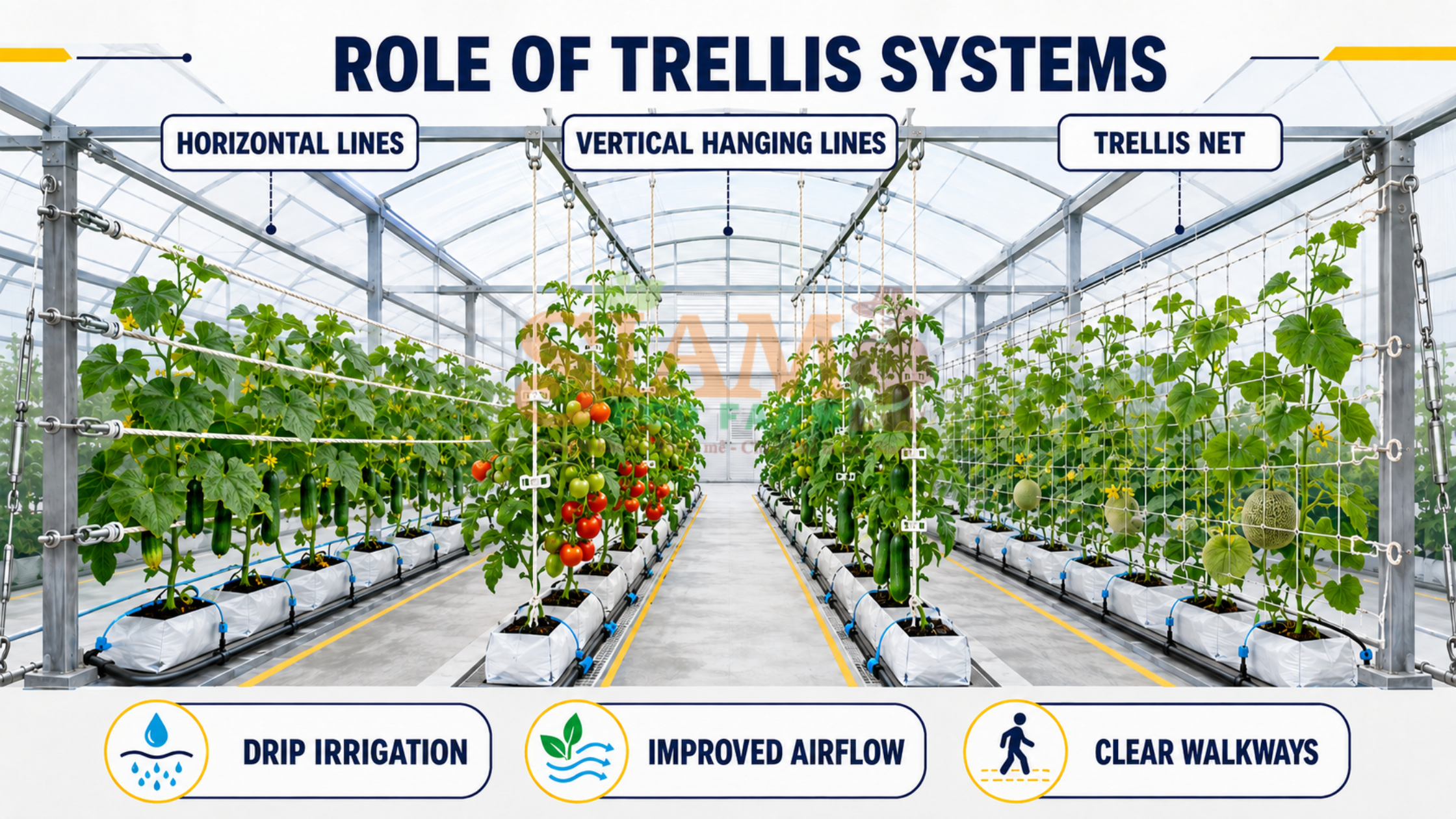
A trellis system generally consists of a supporting frame or anchor points, load-bearing ropes and hanging lines used to support, secure or guide plants. Depending on the crop and farm size, ropes can be stretched horizontally along planting rows, suspended vertically from greenhouse frames or arranged as a net for stems, branches and tendrils to climb.
Trellis systems are often integrated with drip irrigation, pruning practices and nutrient management. When properly designed, they help distribute plant canopies, reduce contact between foliage and the ground, and create clearly defined pathways for workers.
Source: SIAM Brothers Vietnam
Indeterminate tomato plants develop long stems and carry multiple fruit clusters, making continuous support essential. Vertical ropes suspended from greenhouse frames guide the main stems upward and can be used with plant clips or stem-wrapping techniques at different growth stages.
Keeping the plants upright makes pruning, pest and disease monitoring, and harvesting more convenient.
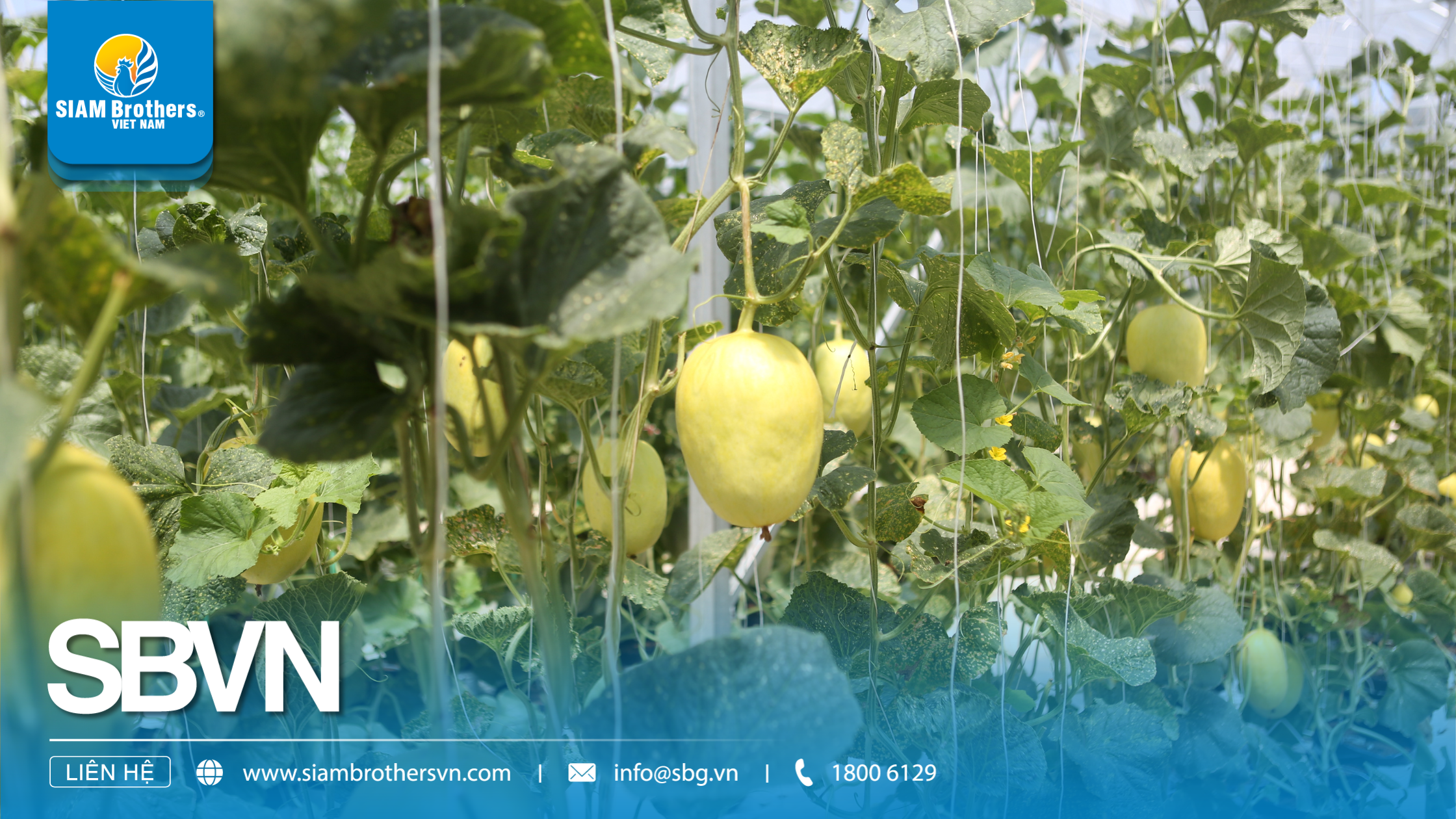
Cucumbers grow quickly and use tendrils to climb. Vertical ropes or rope nets provide a suitable climbing surface, prevent stems from trailing across the ground and reduce the risk of fruit being hidden beneath dense foliage.
Organizing the canopy along planting rows also makes it easier to identify old leaves, weak branches and fruit ready for harvest. The ropes should be sufficiently tensioned without damaging young stems.
Passion fruit is a perennial climbing crop with a large canopy and considerable fruit load. Its trellis system usually requires posts, primary load-bearing ropes and secondary lines to distribute the branches.
The supporting structure must be strong enough to withstand wind, rain and the accumulated weight of the canopy. Proper vine training opens the canopy and creates sufficient space for pruning, supplementary pollination and harvesting.
Trellis systems are also suitable for melons, French beans, bitter melons, pumpkins and certain climbing flowers.
The system configuration should be selected according to the crop’s growth characteristics, foliage and fruit weight, growing period, row spacing and cultivation conditions.
Source: SIAM Brothers Vietnam
Properly installed trellis systems offer several advantages in high-tech agricultural production, particularly where farms need to optimize available space and standardize crop management practices.
4.1. Optimizing Vertical Space
Plants are trained upward instead of spreading across the ground, allowing the space between planting rows to be used more efficiently.
However, planting density must still follow the requirements of each variety and allow sufficient airflow. Density should not be increased arbitrarily simply because a trellis system is available.
4.2. Improving Canopy Ventilation
Stems and leaves are arranged more clearly, reducing excessively dense canopy areas and helping growers detect signs of pests and diseases.
Nevertheless, a trellis system cannot replace proper sanitation and pest management practices within the growing area.
4.3. Simplifying Crop Care and Harvesting
Straight planting rows and relatively uniform plant heights make rope training, pruning, fruit inspection and harvesting easier to organize.
Clear walkways also allow workers to move more conveniently throughout the growing area.
4.4. Reducing Contact with the Ground
Source: SIAM Brothers Vietnam
Lifting stems and fruit away from the ground helps reduce physical impact, dirt contamination and mechanical damage.
Final product quality still depends on several factors, including crop variety, nutrition, irrigation and environmental conditions.
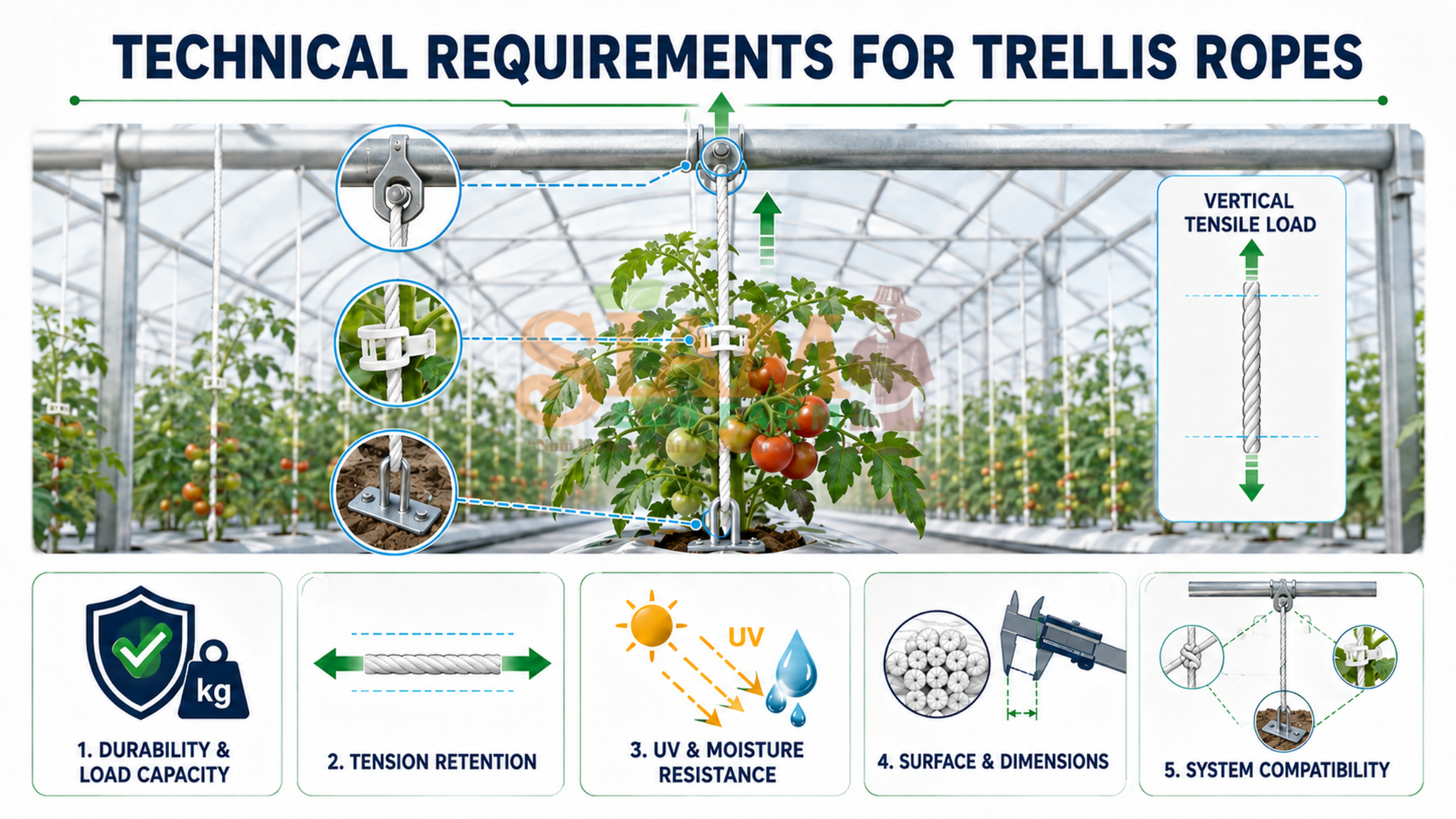
A trellis system remains stable only when its ropes are suitable for the expected load and operating conditions. Ropes that sag, deteriorate or break during the growing season can cause plants to collapse, branches to snap and crop care activities to be disrupted.
When selecting trellis ropes, growers should consider the following criteria:
5.1. Durability and Load-Bearing Capacity: The ropes must support the combined weight of stems, leaves and fruit, as well as additional forces caused by wind or worker activity around the trellis.
5.2. Ability to Maintain Tension: Low-stretch ropes help keep plant rows stable and reduce the need for repeated tension adjustments during the growing season.
5.3. Resistance to Sunlight and Moisture: In greenhouses and outdoor environments, ropes are regularly exposed to UV radiation, high temperatures, irrigation water and humidity. Agricultural ropes with suitable UV resistance can reduce the risk of premature deterioration.
5.4. Suitable Surface and Dimensions: Ropes should be easy to handle and should not have surfaces that are excessively sharp or abrasive at points of contact with plants. Their diameter and construction should also be compatible with clips, hooks, posts and tying methods.
5.5. Overall System Compatibility: In addition to the ropes, growers must inspect the posts, anchors, greenhouse frames and connection points. High-quality ropes cannot compensate for a weak supporting frame or an unevenly distributed load.
Source: SIAM Brothers Vietnam
Before installation, growers should determine the expected maximum crop load, cultivation height, planting row length and distance between anchor points.
For short-cycle greenhouse crops, vertical hanging ropes should be easy to adjust and replace. For passion fruit and other climbing crops with large canopies, priority should be given to long-lasting load-bearing structures that can distribute weight across the entire trellis.
After installation, knots, metal contact points and areas regularly exposed to sunlight or moisture should be inspected periodically. Ropes that show signs of fraying, brittleness, deformation or knot slippage should be replaced before the plants reach their maximum load.
Growers should also record rope specifications, installation dates and inspection schedules. This information helps standardize maintenance and provides a more accurate assessment of material service life across different growing seasons.
To support greenhouse, net house and climbing crop systems, SIAM Brothers Vietnam provides a range of agricultural ropes for applications such as greenhouse crop support, climbing plant trellises and crop stabilization.
According to information published by the company, several specialized rope products are designed to provide load-bearing performance, durability and UV resistance under agricultural conditions.
The appropriate rope should be selected according to the crop, expected load, service period and actual trellis structure. Growers should discuss technical specifications with the supplier before proceeding with large-scale installation.
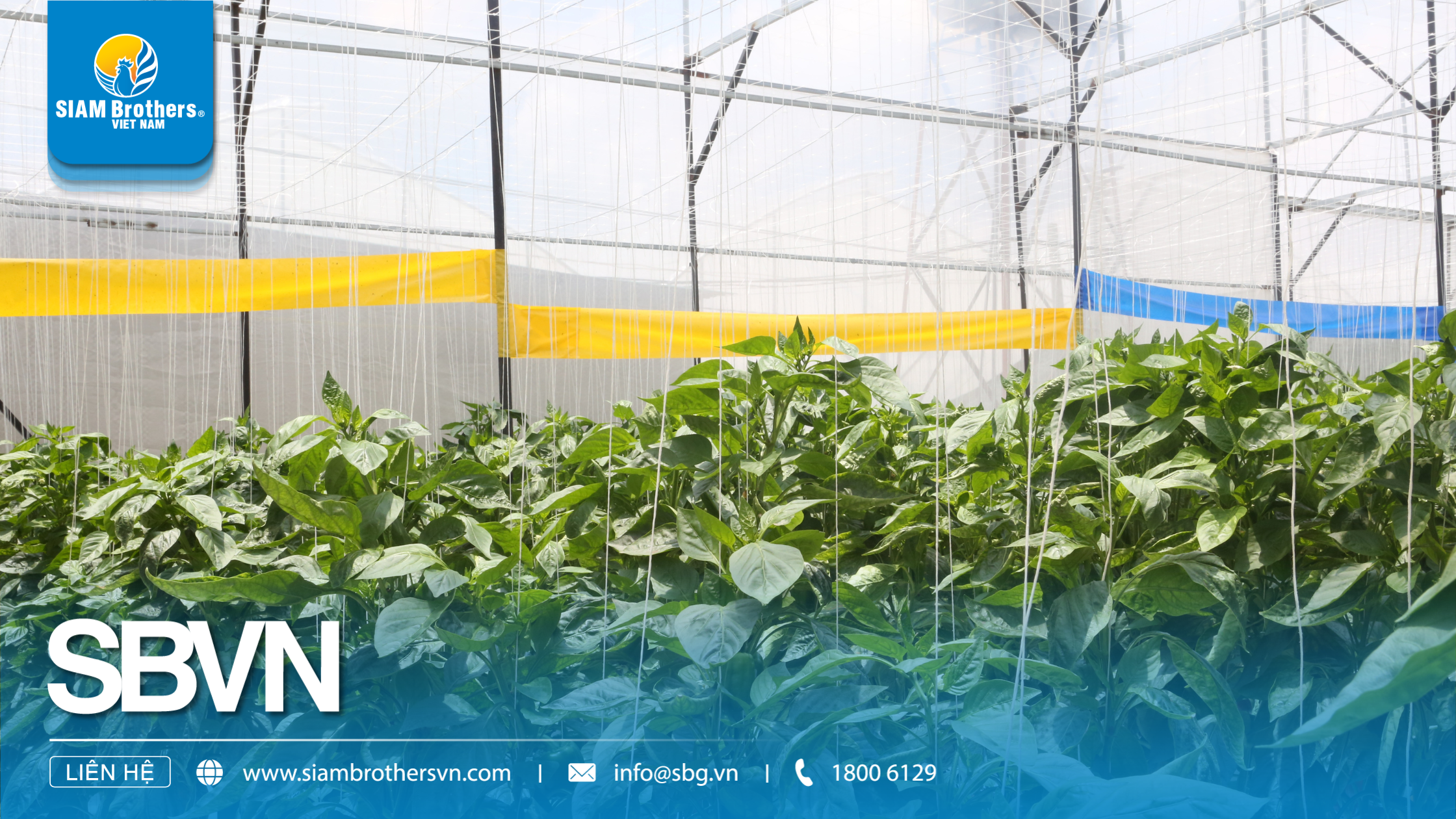
Source: SIAM Brothers Vietnam
Trellis systems help organize crops vertically, improve working space and increase consistency in high-tech agricultural production. Each system should be designed for the specific crop and use ropes with suitable durability, tension retention, and resistance to sunlight and moisture.
Investing in an appropriate trellis structure and suitable materials from the beginning can help growers reduce disruptions during the growing season, lower maintenance requirements and maintain a more stable cultivation area.
Read more: Easy-to-Grow Climbing Plants: 10 Great Options for Gardens, Greenhouses, and Balconies
Source: SIAM Brothers Vietnam
FAQ - Frequently Asked Questions
Q: Which crops are suitable for trellis systems?
A: Trellis systems are commonly used for indeterminate tomatoes, cucumbers, melons, passion fruit and many other climbing crops. The configuration should be adjusted according to plant biomass, fruit load and cultivation period.
Q: How tight should trellis ropes be?
A: The ropes should be tight enough to keep plants stable but should not place excessive stress on the frame, posts or anchor points. The appropriate tension depends on the expected crop load.
Q: How often should trellis ropes be inspected or replaced?
A: Ropes should be inspected throughout the growing season and before plants reach their heaviest load. They should be replaced if they show signs of fraying, brittleness, sagging, deformation or damage around the knots.
Contact us:
Address: 5th floor, VRG Building, 177 Hai Ba Trung Street, Vo Thi Sau Ward, Ho Chi Minh City, Vietnam
Tel: (+84) 28 38 912 889
Hotline: 1800 6129
Facebook: www.facebook.com/siambrothersvn
Email: info@sbg.vn
YouTube: youtube.com/@siambrothersvietnam1728
OA Zalo: zalo.me/1402339229697925373
App SBVN ID:
CHPlay: https://bit.ly/SBVNID-Android
Appstore: https://bit.ly/SBVNID-iOS








Specializing in Agricultural and Fisheries Products & Multipurpose Wire